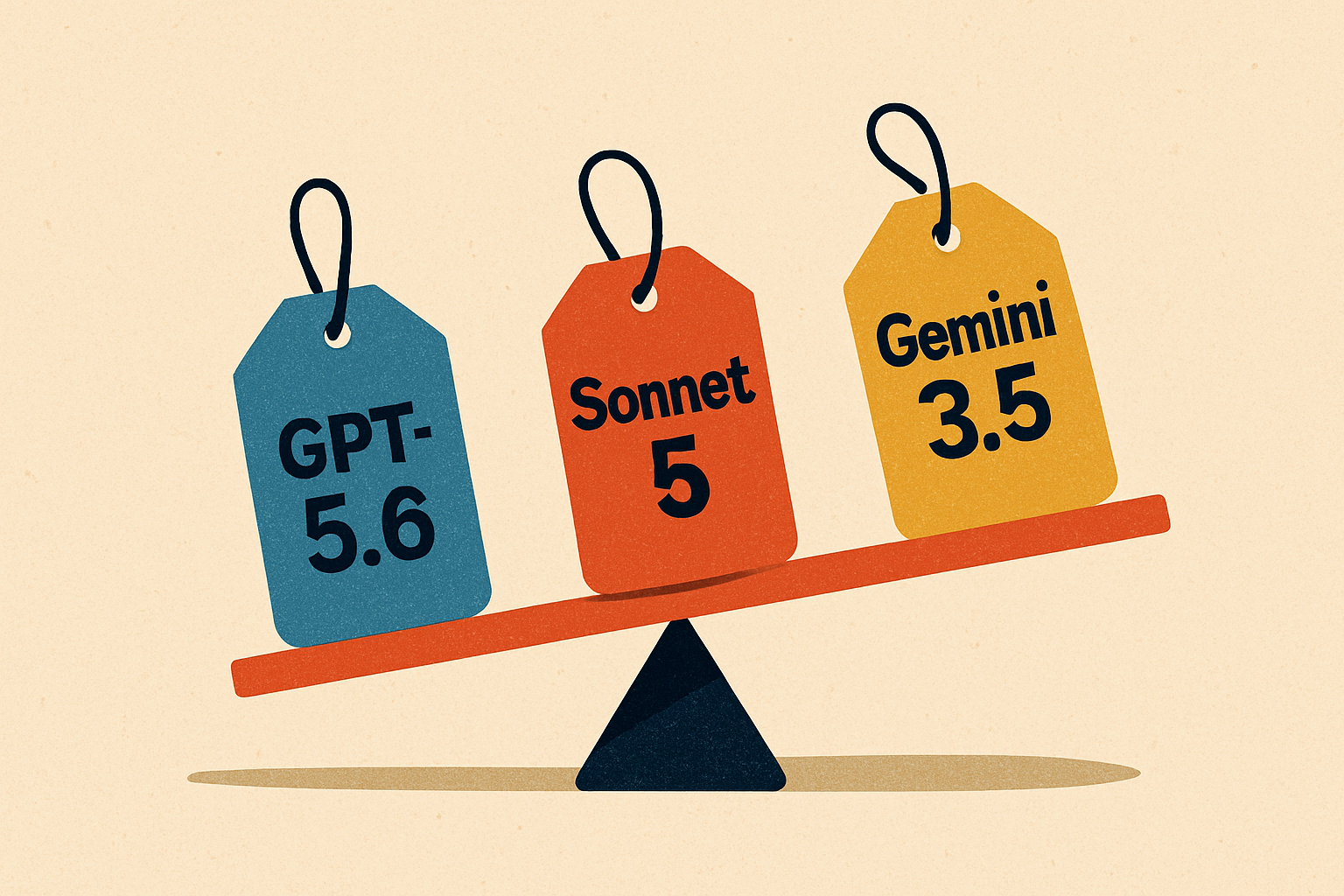
The short version: In ten days, all three frontier labs refreshed their lineups, and the fight moved to the middle. GPT-5.6, Claude Sonnet 5, and Gemini 3.5 are all pitched at the same buyer — the founder who runs a model in a loop thousands of times a day and cares more about the bill than the leaderboard. That buyer just got a better deal, and one trap.
Here is what actually shipped, and what each item means for a small team.
1. OpenAI made GPT-5.6 generally available — after a 12-day government gate#
OpenAI opened the GPT-5.6 family to everyone on July 9, across ChatGPT, the API, and Codex. It's three models, not one: Sol (frontier, $5/$30 per million), Terra (the balanced everyday model, $2.50/$15), and Luna (fast and cheap, $1/$6). A premium Sol Fast tier runs the flagship at up to 750 tokens/second on Cerebras wafer-scale hardware — roughly fifteen times typical GPU throughput — for $12.50/$75.
The launch is notable for how it happened: the release sat behind a temporary federal restriction for twelve days, lifted on July 8 per Axios, before OpenAI flipped it to general availability the next day.
What it means: Terra is the model most teams will reach for — it's the "5.5-level intelligence at half the cost" tier. If you need latency for a live UX, Sol Fast on Cerebras is a genuinely new option, but it's a premium line item; reserve it for user-facing streams, not batch jobs.
2. Claude Sonnet 5 is the cheap-agents play — with an asterisk#
Anthropic shipped Claude Sonnet 5 at the end of June with near-Opus 4.8 performance and introductory pricing of $2 per million input / $10 output, held through August 31 (then $3/$15). TechCrunch framed it plainly: a cheaper way to run agents. For comparison, Opus 4.8 is $5/$25.
The asterisk is the tokenizer. Sonnet 5 uses an updated tokenizer that can map the same text to roughly 1.0–1.35x more tokens than before.
That detail is easy to miss and expensive to ignore. A published per-token price only tells you cost-per-task if the token count holds steady. If your prompts land at the high end of that range, Sonnet 5's effective cost drifts back toward the previous generation's — the discount is partly given back at the meter. Before you migrate a high-volume workload, replay a real sample and compare total spend, not the rate card.
3. Google shipped the cheap half of Gemini 3.5 — and delayed the expensive half#
Gemini 3.5 Flash shipped on time at $1.50/$9 (with cached input as low as $0.15) and a 1M-token context window. The frontier Gemini 3.5 Pro, promised for June at I/O, slipped to July after enterprise testers flagged reasoning and coding regressions in pre-release builds. Google also pushed its agent stack forward — Antigravity 2.0, an Antigravity CLI and SDK, and Managed Agents in the Gemini API.
What it means: On sticker price, Flash is the cheapest serious option on this list. Its 1M context is the differentiator for RAG-heavy or long-document work. The Pro slip is a reminder that a shipped Flash doesn't mean the top of the line is ready — if you were waiting on 3.5 Pro for a hard reasoning task, keep your fallback warm.
4. The regulatory whiplash is now part of your release planning#
Two of this week's stories share a subplot: export-control and release timing set by policy, not engineering. Anthropic's Fable 5 flagship only came back online July 1 after a June 12 order was narrowed; GPT-5.6 sat behind a White House gate for twelve days. Neither outage was about the model.
What it means: Single-vendor dependency now carries a policy risk that has nothing to do with uptime SLAs. If a model vanishing for two weeks would break your product, an abstraction layer that lets you swap providers is no longer just a cost hedge — it's a continuity plan.
The one-line takeaway#
The mid-tier is now a price war, and founders win it by default. Terra, Sonnet 5, and Gemini 3.5 Flash are all "good enough to run in a loop," and they're all cheaper than last quarter's equivalents. Pick on your real traffic — output-token volume and true token counts, not the headline rate — and keep a second provider wired in. The models will keep leapfrogging; your ability to switch between them is the durable advantage.