Mistral shipped its first physical-AI model on July 8, and the headline number is the kind that reorders a roadmap: 76.6% success navigating environments it has never seen — using a single RGB camera and a sentence. No LiDAR. No depth sensor. No map. And that number is not merely good for a cheap setup; it beats the best rigs that carry depth sensors and multiple cameras by 4.5 points.
For a decade the unspoken law of mobile robotics has been more sensors, more accuracy. Robostral Navigate breaks it, and the consequences run straight to the bill of materials.
What it actually does#
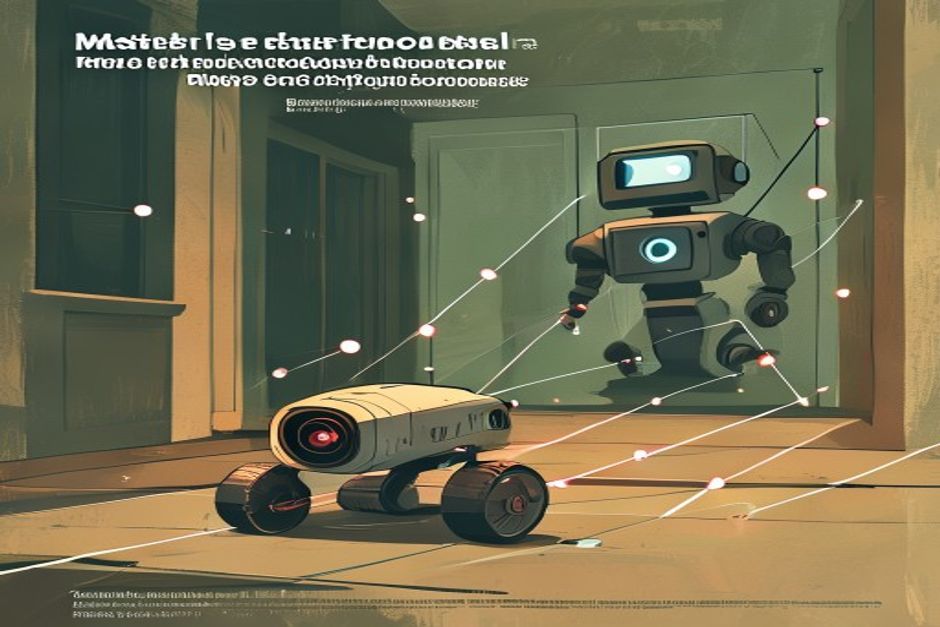
You give it an instruction in plain language — "go down the hall and stop at the second door" — and a live feed from one ordinary camera. The 8-billion-parameter model turns that into motion through a space with no prior map, continuously, in what the benchmark world calls a continuous environment (real-valued steps, not a tidy grid of nodes).
On R2R-CE, the standard vision-and-language navigation benchmark, it posts 79.4% on validation-seen and 76.6% on validation-unseen. The unseen split is the honest one — it measures whether the thing generalizes to a house it wasn't trained on — and there it clears the previous best single-camera system by 9.7 points and the best multi-sensor systems by 4.5.
For ten years the rule was "more sensors, more accuracy." A model that reads one commodity camera better than a rig reads its whole sensor suite just repealed it.
Why a software founder should read past the robotics headline#
Skip the servos; the interesting parts are economic and temporal.
The cost floor moved. In mobile robotics, compute was never the expensive part — sensing was. LiDAR units, depth cameras, calibration, and the integration tax are what put a comma in the price of an autonomous mobile robot. A model that extracts more navigation accuracy from a $30 webcam than the field previously got from a depth rig doesn't shave the cost curve; it kicks out a support beam under it. Any product whose economics were blocked by "the sensor stack is too expensive to ship at consumer prices" should re-run that spreadsheet.
The data moat got shallower. Robostral Navigate was trained entirely in simulation — ~400,000 trajectories across 6,000 scenes — then polished with online RL, and Mistral says it was built in-house, not fine-tuned off an existing open-weight model. The load-bearing claim there is that sim-to-real transfer worked. The classic reason physical-AI startups needed deep pockets was real-world data collection: fleets, teleoperators, months in the field. If a leading result can come out of a simulator, the barrier to entry for embodied products drops the same way it dropped for language products when pretraining data stopped being proprietary.
The timeline compressed — again. Most operators filed "physical AI" under 2027-and-beyond, a category to watch but not to plan around. A benchmark-leading, on-robot-sized (8B) model shipping in the middle of 2026 is the tell that the category is landing on the same accelerated schedule the rest of AI has trained you to expect. You do not need to build a robot to update the assumption. You need to stop pricing "embodied" as a problem that stays safely far away.
The caveat that keeps it honest#
A benchmark is a benchmark. R2R-CE is a respected, standardized test, but success on curated indoor navigation episodes is not the same as reliability in a warehouse with forklifts, glare, and a spilled pallet. "State of the art on unseen validation scenes" is a real and hard-won result; "ready to trust unsupervised in your building" is a different, longer claim that no single number settles. Read 76.6% as the capability line moved here, not the problem is solved.
But the direction is unambiguous, and it rhymes with the pattern you already know from software: a task everyone agreed was expensive and years out gets a small, cheap-to-run model that does most of it, and the roadmap it sat on quietly compresses. Mistral just ran that play in the physical world. The founders who win the next round are the ones who noticed the sensor suite became optional before their competitors reprinted the same old BOM.