There's a version of Ollama most people still carry in their heads: a nights-and-weekends way to run Llama on a MacBook. That version is two years out of date. On July 9, 2026, Ollama raised a $65M Series B (led by Theory Ventures) and reported roughly 8.9M monthly developers — about double January's. It's worth a fresh look, because it quietly became the thing that makes "just self-host the open-weight model" a sentence a founder can actually say without flinching.
What it actually is#
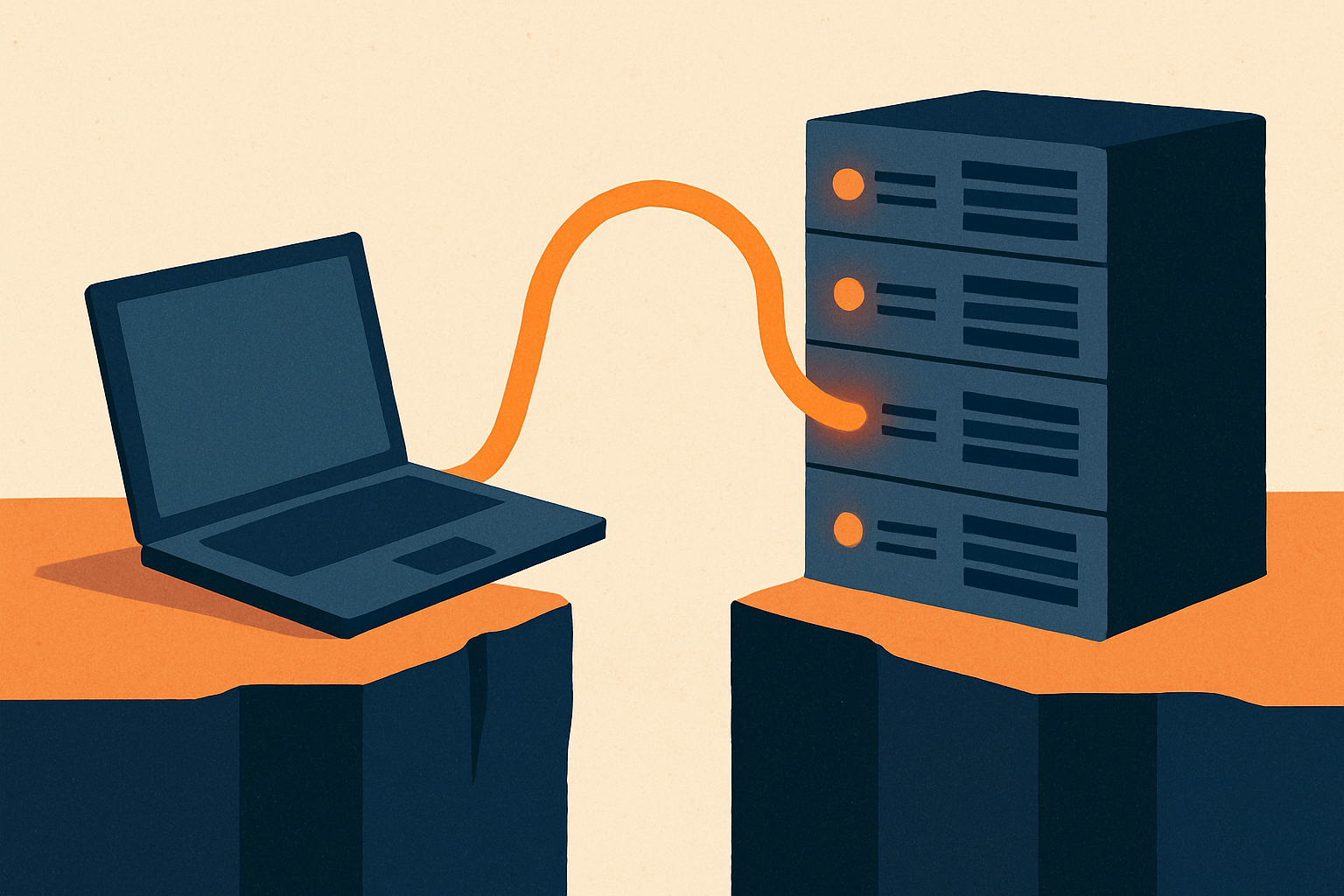
Ollama is an MIT-licensed tool, written in Go on top of llama.cpp, that downloads and runs open-weight models on your own hardware and puts a clean API in front of them. Two APIs, really: its own REST endpoint, and — the one that matters — an OpenAI-compatible surface on http://localhost:11434/v1. That compatibility is the whole trick. Your existing code that talks to /v1/chat/completions doesn't know or care that the model is now running on your machine.
curl -fsSL https://ollama.com/install.sh | sh   # macOS / Linux
ollama pull kimi-k2.7-code                       # fetch an open-weight model
ollama serve                                     # OpenAI-compatible API on :11434
from openai import OpenAI
client = OpenAI(base_url="http://localhost:11434/v1", api_key="ollama")
r = client.chat.completions.create(
model="kimi-k2.7-code",
messages=[{"role": "user", "content": "Refactor this function..."}],
)Change one line — the base_url — and the same script that hit a cloud vendor now runs a local model. That's the seam.
Why founders should care in 2026#
Three things have moved it from hobby tool to infrastructure.
The library caught up. The models a small team actually wants are one pull away: kimi-k2.7-code, glm-5.1, deepseek-v4, the qwen3.5 family, llama, gemma4, minimax. When Copilot added Kimi as an open-weight option, the reason that mattered was portability — and Ollama is where the portability gets cashed in. The exit only counts if the door opens easily; this is the door.
Local and cloud became the same API. Ollama Cloud runs the bigger models — the ones that won't fit on your laptop, like Kimi's 1T-parameter MoE — on managed GPUs, addressed by adding a :cloud suffix to the model name. Same endpoint, same SDK, same code. You prototype against a small local model for free, and promote the heavy calls to :cloud by changing a string, not rewriting your stack. Local is free under MIT; Cloud is a paid tier (a free plan plus paid monthly plans, reported around $20 and $100/month, metered by GPU time — confirm current pricing on their site).
It moved up into the agent layer. ollama launch claude, ollama launch codex, ollama launch opencode wire a local model straight into a coding agent, so a team can run a self-hosted coding assistant without paying per seat for a hosted one. Add tool calling, JSON-schema structured outputs, embeddings (nomic-embed-text), and vision, and the feature gap with the hosted APIs is mostly closed for everyday work.
Who it's for#
- Compliance-sensitive prototyping — health, legal, fintech. Run everything on-device or on-prem; nothing leaves your machine, and there's no per-token meter while you experiment on regulated data.
- Cost-controlled development and CI — point OpenAI-SDK code at
localhost:11434, develop against free local models, and flip only the heavy calls to:cloudwhen you genuinely need frontier capability. - Self-hosted coding agents — pair
ollama launchwith an in-library coding model to give a small team an assistant they own, priced in GPU time instead of seats.
It isn't magic: a 1T-parameter model still wants real GPUs, so the largest models are cloud-tag or serious-hardware territory, not a laptop trick, and open-weight is behavior you can inspect, not training data you can see. But for the specific job of turning "we could run the model ourselves" from a slide into a command, Ollama is now the shortest path there — and a freshly-funded one.