On July 8, OpenAI shipped GPT-Live and made one phrase the story of the week: listen and speak at the same time. It's a real capability shift, and the demos are genuinely uncanny — the model backchannels, lets you interrupt, and holds the floor while it thinks. If you build voice agents, the temptation is to treat this as the new default and start over.
Don't — not yet, and not for the reason you'd guess. The reason is one line buried under the demos: GPT-Live has no API. It ships inside ChatGPT as GPT-Live-1 and a free GPT-Live-1 mini, delegating harder tasks to a background GPT-5.5, and it's rolling out globally on iOS, Android, and the web. But there's no developer endpoint at launch — just a waitlist — and no published pricing. You can experience full-duplex this week. You can't ship on GPT-Live this week. So the real question isn't "should I switch to GPT-Live." It's "what does full-duplex change, and what should I actually build on today."
What full-duplex actually is#
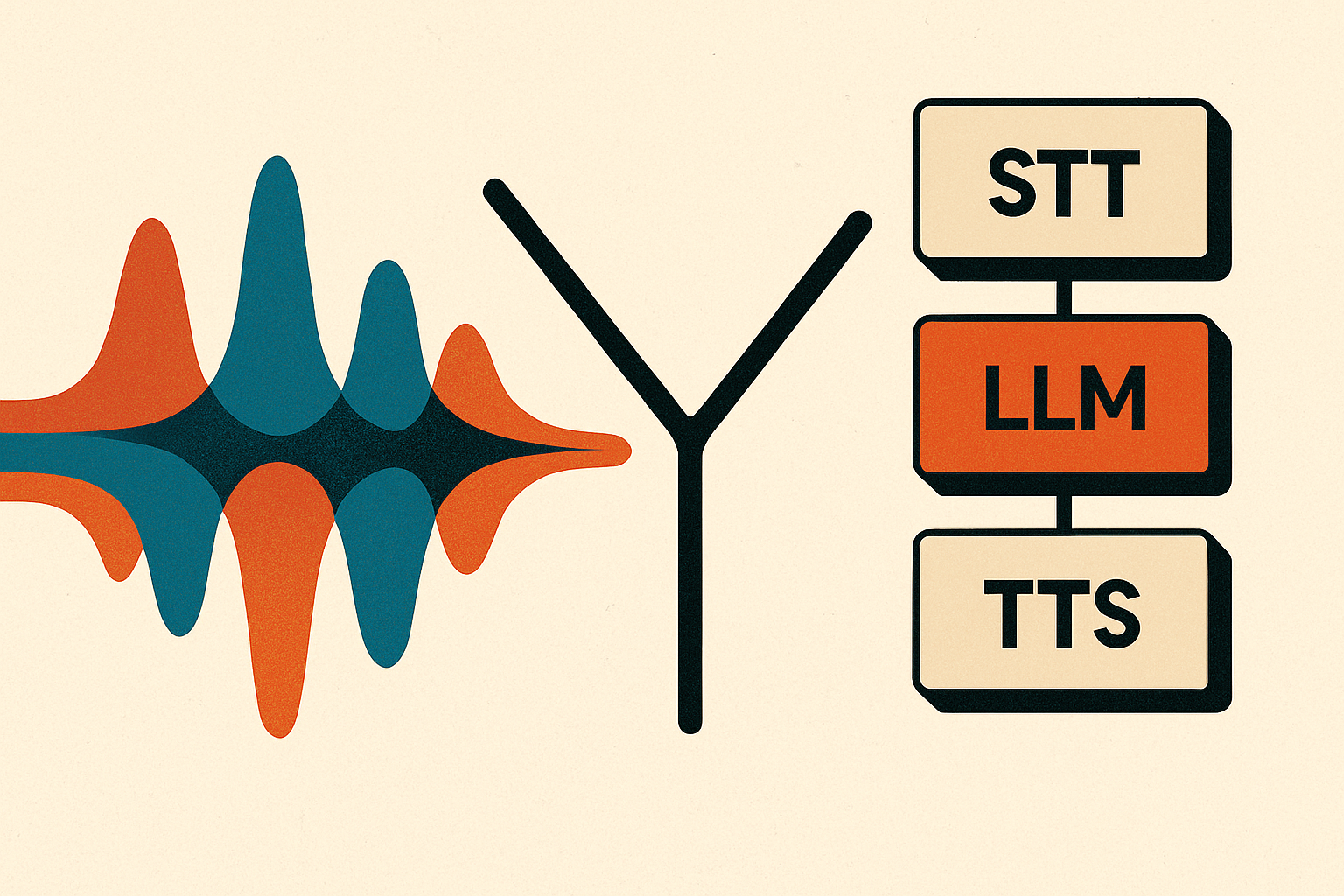
The voice agent you're probably running is cascaded — a relay race. A voice-activity detector (VAD) listens for silence to decide your turn ended (typically a 300–700ms threshold), then hands the audio to speech-to-text, then to an LLM, then to text-to-speech. (We've mapped that pipeline before, in speech-to-speech vs cascaded voice agents and VAD vs semantic turn detection.) It's simple, predictable, and easy to test. It also feels like a relay race: the gap between you stopping and the agent starting is exactly the sum of that pipeline plus the silence you had to hold to prove you were done.
A full-duplex model hears your audio and its own output in parallel, and decides many times a second whether to keep listening, respond, pause, or interrupt. There is no silence gate deciding your turn is over — because there are no turns.
That parallelism is the whole thing. It's what lets the model take a barge-in mid-sentence and stop cleanly, drop an "mhmm" while you're still talking, or stay quiet when you pause to think instead of jumping in. Turn-taking stops being a gate you engineer and becomes a behavior the model has.
What it breaks#
Here's what the keynote skips: full-duplex breaks several things cascaded builders quietly depend on.
- Interruption becomes the core failure mode. The system has to generate audio and listen at the same time, then cut its own speech instantly when you cut in. Slow interruption detection doesn't degrade gracefully — it talks over your user.
- Mid-utterance self-correction wrecks naive tool-calling. People revise in real time: "book a flight to New York — actually, make that Boston." A turn-based agent that fired the tool call on the first noun phrase already booked New York. A full-duplex agent has to hold state, notice the correction, and roll back before it acts. Testing that rollback over continuous, multi-step spoken tool use is still an open problem.
- Your evals go blind. Turn-taking behavior is invisible to transcript-based tests — the transcript of a good and a bad barge-in can be identical. You have to evaluate over real, overlapping audio. Newer benchmarks like Full-Duplex-Bench-v3 pair real human speech (disfluencies and all) with multi-step tool use precisely because the older, synthetic-audio benchmarks miss this.
None of these are reasons to avoid full-duplex. They're the bill that comes with it — and a reason not to bolt it onto a product whose value is reliable tool execution.
The stack you can actually build on#
Full-duplex isn't OpenAI-only, and the buildable options are the interesting ones:
- Kyutai Moshi is open-source, natively full-duplex (it models your stream and its own plus a text "inner monologue"), and runs around 200ms in practice. If you want to own the stack or research the architecture, it's the reference.
- Google Gemini Live offers native-audio dialog with barge-in over WebSockets, plus a half-cascade option that keeps text reasoning in the loop — and, unlike GPT-Live, it has a real API today.
- Cartesia (Sonic-3.5 TTS + Ink-2 STT) and ElevenLabs are cascaded, but fast and vendor-integrated, with strong turn-taking models — the pragmatic choice when you need quality voices and dependable function-calling now.
- LiveKit and Pipecat are orchestrators, not models: they run the media transport and the interruption logic, and let you plug in either a cascaded pipeline or a native speech-to-speech model. They're how you keep observability and the freedom to swap models as this space moves — see LiveKit vs Pipecat vs Vapi for the orchestrator trade-offs.
How to choose#
The axis is naturalness vs. control. Native full-duplex buys human-like barge-in and backchannel; you pay in harder interruption handling, mid-utterance state management, and audio-based eval. Cascaded and orchestrated stacks buy function-calling reliability, observability, and model-swap freedom; you pay in a little conversational stiffness you can engineer down but not fully erase.
So: reach for full-duplex when interruptibility is the product — companions, language tutors, hands-free assistants where the feel of the conversation is the value. Stay cascaded (or orchestrated) when the product is the actions the agent takes, and the voice is the interface, not the point. Keep a cascaded fallback either way, and test on real overlapping audio regardless of which side you land on.
And GPT-Live? Put it in your competitive-radar column, join the API waitlist, and build this quarter's voice feature on something that has a price and an endpoint. The capability arrived on July 8. The buildability will arrive later — and the teams that win the gap are the ones who don't confuse the two.