
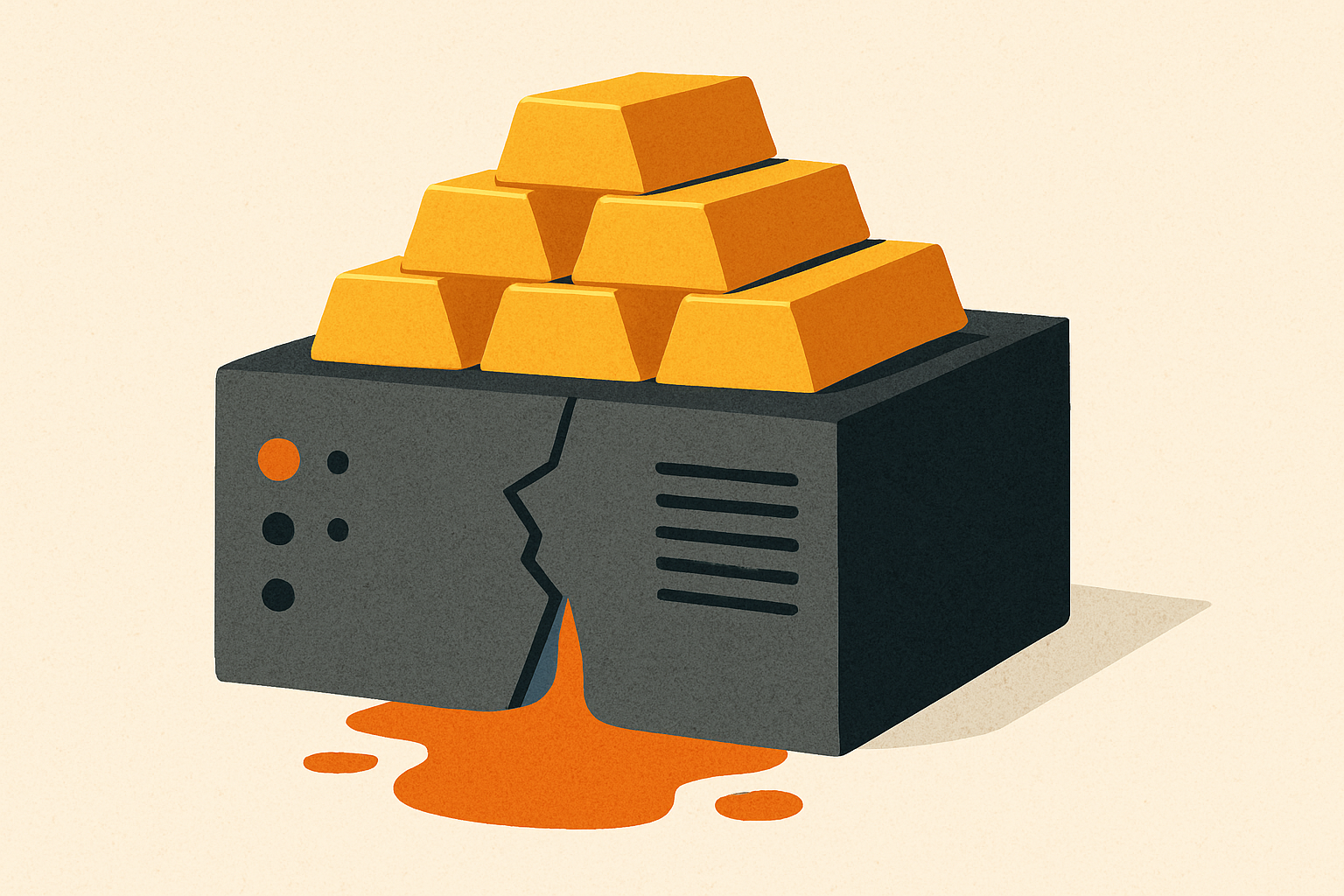
Venture funding hit $510 billion in the first half of 2026 — more than the $440 billion invested in all of 2025, and the biggest half-year on record. Two companies, OpenAI and Anthropic, took $217 billion of it: 43% of every venture dollar raised worldwide.
That's the number to sit with. The AI capital wave has stopped being a story about models and started being a story about everything models need — compute, exits, consolidation, and the security debt piling up underneath. This week gave you one clean example of each.
The 30-second version#
- The record — Global VC hit $510B in H1 2026, past all of 2025; nearly 90 new unicorns minted.
- Compute — Together AI raised $800M at an $8.3B valuation as open-source inference demand triples.
- Consolidation — Figma acqui-hired the team behind vibe-coding app Bud; both Bud and Orchids shut down July 18.
- Exits — Bending Spoons, owner of AOL and Vimeo, IPO'd and closed up ~40% at a $25.7B market cap.
- The bill — A hacker claims 35GB of Accenture source code, keys, and Azure tokens; Accenture calls it an "isolated matter."
The half that broke every record#
H1 2026 didn't just beat prior years — it lapped them. Crunchbase counts $510B in global venture funding for the first six months, more than the $440B raised across all of 2025, with AI taking over 70% of Q2 dollars and OpenAI and Anthropic alone accounting for $217B. Nearly 90 startups crossed the $1B unicorn line, including Jeff Bezos's Prometheus at a $41B valuation on a $12B Series B. If you're raising, the tape looks euphoric — but the concentration is the real signal: two labs took nearly half the money, and most rounds went to repeat founders and elite technical teams. What to do: Don't read the headline number as your market. Read the concentration. Capital is abundant for a narrow band of companies and ordinary everywhere else — price your raise to the median, not the megaround.
Together AI's $800M says the money is moving to plumbing#
Together AI raised an $800M Series C at an $8.3B valuation on July 1, led by Aramco Ventures, with Nvidia, Vista, and General Catalyst in. Sixteen months ago it was worth $3.3B; it now reports annual bookings above $1.15B and plans to grow its infrastructure footprint roughly 50x over five years. The thesis: open-source inference is no longer a hobby — enterprises are running real workloads on open models and renting GPU capacity to do it. What to do: If your product's margins depend on a single closed-model API, price out an open-weight inference path now. The neoclouds exist precisely so you can move, and this raise is a bet that a lot of you will.
Figma buys a vibe-coding team as the wave consolidates#
Figma acquired the team behind Bud (formerly Orchids), a YC-backed vibe-coding and agent platform, and is shutting both products down by July 18. It's an acqui-hire — talent, not product — and terms weren't disclosed. It follows Figma opening its canvas to external coding agents via MCP. Translation: the "spin up an app from a prompt" category is already consolidating into the incumbents that own the design and prototyping surface. What to do: If you're building a thin vibe-coding wrapper, assume the platform you sit on will absorb the feature. Own a workflow or a data moat the incumbent can't cheaply rebuild — and give users an export path so a shutdown notice (Bud users got about eight days) doesn't torch them.
Bending Spoons' IPO reopens the exit window#
Bending Spoons — the Milan roll-up firm that owns AOL, Vimeo, and Evernote — priced its IPO at $29 (above range), raised $1.68B, and closed its first day up nearly 40% at $40.50, a ~$25.7B market cap. Its playbook is unglamorous: buy underperforming subscription software, cut costs hard, hand it to in-house engineers. Public markets just paid a premium for it. Combined with a Q2 that produced the largest venture IPO and M&A deals on record, the exit window is genuinely open again. What to do: If you've been sitting on a secondary or an acquisition conversation waiting for "conditions," conditions are here. And if you're sub-scale, the Bending Spoons model means a disciplined acquirer may be a better outcome than a doomed Series B.
Accenture's 35GB leak is your supply-chain problem#
A threat actor using the handle "888" claims to have stolen 35GB from Accenture — source code, RSA and SSH keys, and Azure access tokens — and posted proof from a private Azure DevOps repo. Accenture says it is "aware of this isolated matter" and has "remediated its source," without confirming exfiltration. Whether or not the full haul is real, the exposed material — keys and tokens — is exactly the kind that pivots into client environments. What to do: Inventory which vendors and contractors hold your source code, secrets, or cloud tokens, and rotate anything shared with a large outsourcer. Enforce short-lived tokens and per-repo scoping now, not after your name turns up in someone else's breach post.
The pattern#
Strip the euphoria and the week rhymes. Record money is chasing a narrower and narrower set of winners, and the dollars that aren't going to the top two labs are flowing to the layer underneath them — inference capacity (Together), the tools that turn prompts into shipped software (Figma), and the public-market vehicles that let all of it cash out (Bending Spoons). The AI boom is maturing from "who has the best model" into "who owns the picks, shovels, and exits." For founders, that's clarifying: the safest places to build are the workflows and infrastructure the giants still need, not the features they can absorb. And the Accenture leak is the unglamorous footnote every boom produces — the faster everyone ships and outsources, the more your security perimeter is really your vendors' perimeter. Move on the open window, but rotate your keys first.