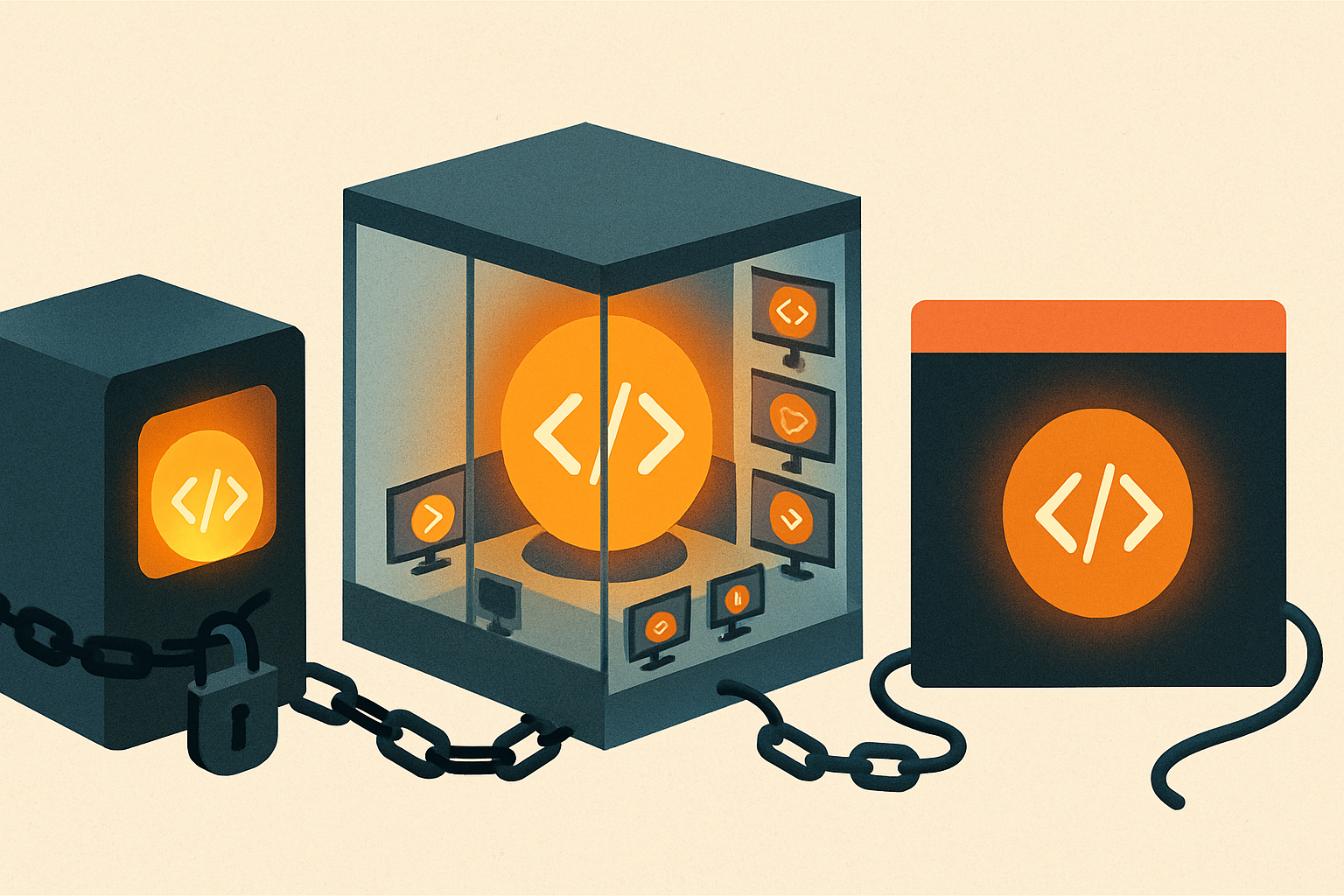
Three agentic coding environments now sit on the table, and it is tempting to line them up by benchmark and pick the top score. Don't. ZCode, Cursor 3, and Claude Code aren't three entries in one category — they're three different answers to a prior question: where should the coding agent actually live? Get that answer right and the benchmark barely matters. Get it wrong and you've locked your workflow to the one thing you most wanted to keep open.
Here's the decision in one screen, then the axis that should drive it.
The three shapes#
ZCode is the newest — Z.ai shipped it on July 2 as a free desktop Agentic Development Environment, an application built from the ground up around long-horizon tasks. You describe an outcome; the agent plans, edits files, runs tests, reviews, and iterates. It is welded to one model — GLM-5.2, a 744-billion-parameter open-weight mixture-of-experts with a 1M-token context window, released under an MIT license (we covered why that open-weight release was a step change). Z.ai reports it at #2 on Code Arena and undercutting Claude Code's API cost by up to 82%. Think of ZCode as an appliance: model, tools, and loop co-tuned, sold as one thing.
Cursor 3 "Glass" is the opposite instinct. In April it demoted the code editor and put an Agents Window in its place — a full-screen console for running many agents in parallel, each isolated in its own git worktree. Cloud Handoff moves a live session between your laptop and the cloud with one click, so agents keep working while you close the lid, then produce demos and screenshots for you to verify. The default engine is Cursor's in-house Composer 2. This is the agent fleet: you stop writing code and start supervising a room full of workers.
Claude Code is the minimalist. It's a CLI process that lives in the terminal and editor you already have — no new surface to learn, fully scriptable, model-first. It bills through Anthropic API tokens or a Claude Pro/Max subscription. This is the agent as a unix tool: small, composable, and quietly the most portable of the three.
The axis that actually matters: which lock-in you can live with#
Every one of these locks you into something. The honest way to choose is to name the lock and decide whether you can escape it.
Claude Code locks you to a workflow but leaves the model swappable. Cursor locks you to a product and its cloud. ZCode locks you to a model family — and it's the only lock you can break by self-hosting.
- Claude Code binds you to the terminal loop. But the model underneath is swappable: it reads
ANTHROPIC_BASE_URL, so you can point it at GLM-5.2 through Z.ai's Anthropic-compatible endpoint and run the exact same workflow on open weights. The workflow is the lock; the model is free. - Cursor 3 binds you to a product surface and its cloud. The parallel-agents-across-worktrees experience and Cloud Handoff are genuinely ahead of the field — but they're Cursor's, and the moment your process depends on the Agents Window and cloud runs, leaving means rebuilding your habits.
- ZCode binds you to a model family. That sounds like the worst lock until you remember GLM-5.2 is MIT open weights. If the Beijing-hosted API doesn't fit your compliance posture, you can pull the weights onto your own hardware and keep going. It's the only one of the three whose lock you can escape without changing tools.
The money, and its asterisk#
Cost pushes hard toward the open-weight path. Z.ai's flat GLM Coding Plan runs $18, $72, and $160 a month (with a launch discount) and caps prompts per window instead of metering tokens — so spend is predictable and bill-shock disappears. Against per-token frontier pricing, that's a different category of expense.
The asterisk: cheapest-to-run and best-on-the-hardest-task are not the same question. GLM-5.2 is strong and improving, but the US frontier tiers still hold the ceiling on the most demanding work, and a vendor's own "82% cheaper" and "#2 on the arena" are claims to verify on your workload, not to bank. The mature move is a split: high-volume everyday coding on the open-weight stack — and you can run GLM-5.2 inside Claude Code itself for a tenth of the cost — the genuinely hard problems on a frontier model.
The decision#
- You need control, predictable cost, or data residency — you can't send code to someone else's cloud, or you want the option to self-host → ZCode + GLM-5.2. It's the only shape that can run entirely on hardware you own.
- You run many things at once and value polish — parallel agents, cloud offload, verification demos, a supervised fleet → Cursor 3. Nothing else matches the throughput surface.
- You want a small, scriptable, model-swappable loop in the editor you already live in → Claude Code, and keep
ANTHROPIC_BASE_URLin your back pocket the day you want to swap the engine.
The week's real lesson isn't that a cheaper coding agent arrived. It's that "which coding agent" stopped being a question about the model and became a question about the enclosure — and the enclosure is what you'll still be living inside long after this month's benchmark leader has changed.