Ask which AI coding tool is "best" and you'll get a benchmark fight. That's the wrong axis, and 2026 has made it obvious why. The headline benchmark — SWE-bench Verified — has saturated and contaminated to the point that OpenAI stopped reporting it early this year; the frontier models all cluster above 80% and the number no longer discriminates between tools. Meanwhile the companies keep getting bought and rebranded out from under their users. Choosing on this quarter's score, or even on a brand, is choosing on the thing most likely to change.
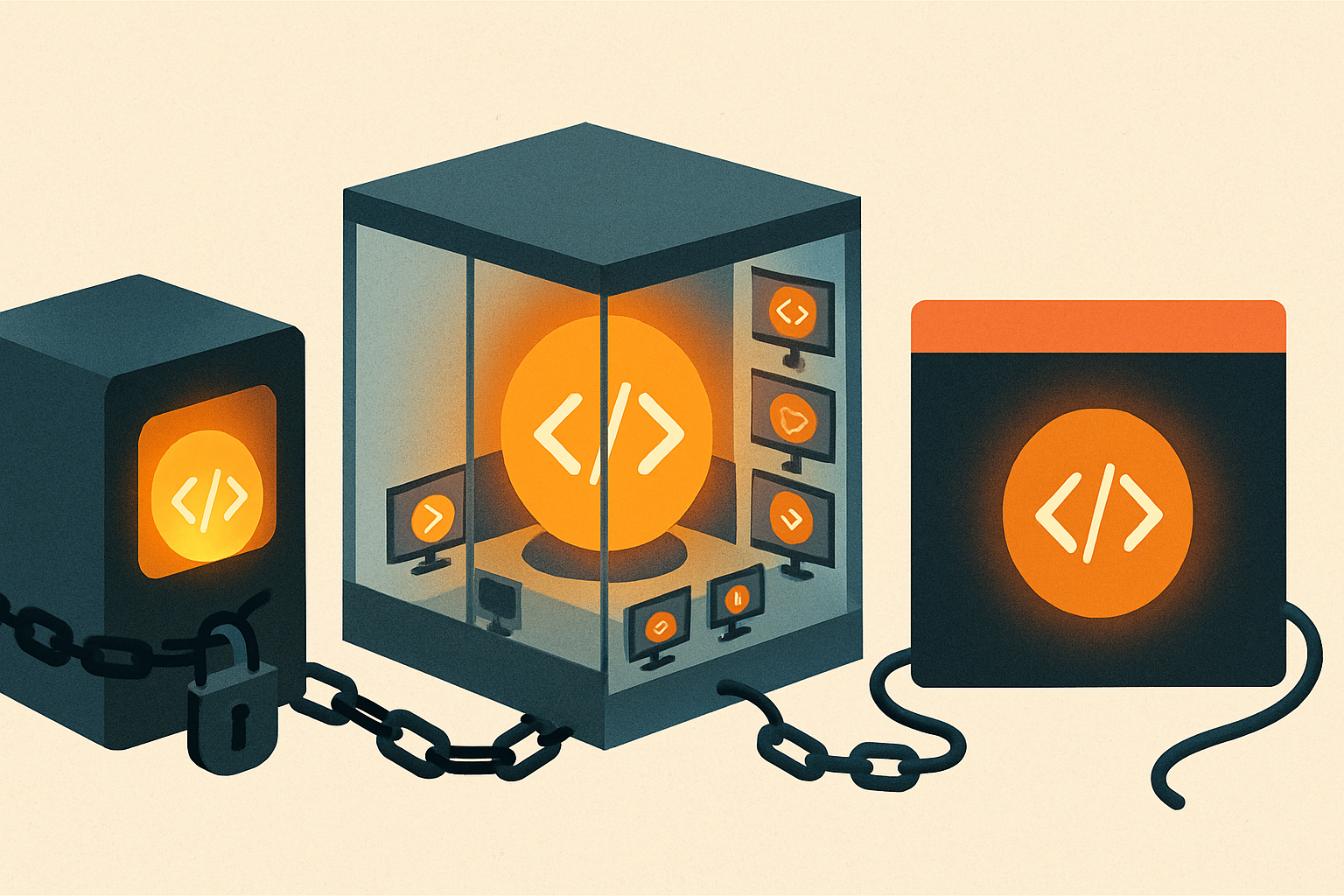
The thing that doesn't change is posture: where the AI actually lives relative to your editor. There are three, and the four tools sort cleanly into them.
Posture one: the AI-native editor#
Cursor and Windsurf are both forks of VS Code with AI woven through the entire surface — autocomplete, an in-editor agent, and increasingly background agents that work in parallel. The bet is that if AI is central enough to your workflow, the editor itself should be rebuilt around it rather than have AI bolted on.
Cursor (built by Anysphere) is the standard-bearer: Tab completion, the Composer/Agent mode, background agents, and as of October 2025 its own in-house coding model, "Composer." It raised at a $29.3B valuation in November 2025 — and then, in June 2026, SpaceX announced it would acquire the company in an all-stock deal reported around $60B, pending close. The best AI-native editor on the market is about to become a subsidiary of a rocket company.
Windsurf is the cautionary half of this posture. Formerly Codeium, it rebranded in 2025 around its "Cascade" agent — and then went through one of the strangest ownership sagas in software. A reported ~$3B OpenAI acquisition collapsed in July 2025; the same day, Google DeepMind hired Windsurf's founders and licensed its tech for about $2.4B; days later, Cognition — the company behind the Devin agent — bought what remained, employees and product included. Windsurf has since been folded toward Cognition's Devin line. If you'd standardized your whole team on Windsurf in early 2025, you spent the next year watching your tool get dismembered and reassembled under three different owners.
The AI-native fork gives you the deepest experience and the largest lock-in surface: you're not adopting a feature, you're adopting an editor — and possibly an acquirer.
Posture two: the plugin to the editor you already use#
GitHub Copilot is the incumbent precisely because it refuses to make you switch editors. It's a plugin that adds AI to VS Code, JetBrains, Visual Studio, and the CLI, and it has ridden GitHub's distribution to scale no one else has — GitHub reported passing 20 million all-time users in 2025 and usage across most of the Fortune 100.
Copilot has also quietly matured along the autonomy spectrum. It went multi-model in late 2024 (Claude, Gemini, and OpenAI models, selectable), added an in-IDE agent mode in early 2025, and shipped a genuinely autonomous coding agent — assign it a GitHub issue and it opens a draft PR and runs your tests — that went generally available in September 2025. Two distinct things share the "agent" word here: the synchronous in-editor agent and the asynchronous cloud coding agent. Don't conflate them.
The 2026 wrinkle is billing: Copilot moved to usage-based pricing mid-year, metering agentic work by token consumption while keeping plain completions free. Heavy agent users have seen bills jump sharply. The plugin posture's whole appeal is low switching cost — just know the meter is now running on the autonomous parts.
Posture three: the terminal#
Claude Code is the bet that the right home for an autonomous coding agent isn't a GUI at all — it's the command line, where it can be scripted, piped, and dropped into CI. Anthropic ships it as a CLI with companion IDE extensions and a web version that runs in managed sandboxes. It's the one tool here that is not model-agnostic — it runs Claude models only — which is either a liability (no model choice) or the point (one vendor owns the whole loop), depending on your taste.
It's also, by revenue, the fastest-growing of the four: Anthropic disclosed alongside its February 2026 Series G that Claude Code had surpassed a $2.5B annualized run-rate, more than doubling in weeks. The CLI posture rewards teams that already automate everything and want their coding agent to behave like every other tool in the pipeline. (For the open-source take on this same terminal-native posture, see aider vs Cline vs OpenHands.)
How to actually choose#
Stop benchmark-shopping and choose the posture that fits how you already work, because the posture is what survives the next acquisition:
- Want the deepest AI-native experience and willing to switch editors? A fork — Cursor today, with the caveat that you're betting on a tool mid-acquisition. The depth is real; so is the corporate churn.
- Want to keep your editor and your habits? GitHub Copilot. Lowest friction, broadest model choice, hardest to dislodge — just watch the usage meter on the agentic features.
- Live in the terminal and automate everything? Claude Code. Scriptable, fast-growing, Anthropic-only.
The uncomfortable lesson of the last twelve months is that the brand on your coding tool is not a stable thing to commit to. The posture is. Pick the shape of the integration — fork, plugin, or CLI — that you'd still want even if a different logo were printed on it next quarter. Because, on current evidence, one will be.