
Claude Code in VS Code: How to Set It Up and Actually Use It (September 2026)
The fastest path from a fresh VS Code install to Claude editing your repo — the exact install commands, how to open the panel, and the five keyboard moves that make it feel native instead of bolted on.
7 min
Vibe Coding, Explained: What It Actually Means, the Apps Founders Use, and When It Breaks
Vibe coding means describing what you want in plain language and shipping whatever the AI produces without reading the code. Here's the precise definition, the apps a solo founder actually reaches for in 2026 — Lovable, Bolt, v0, Cursor, Claude Code, Replit — and the exact point where it stops working.
7 min
How to Use Claude Code in VS Code: Install, Inline Diffs, and When to Stay in the Terminal
Install the Anthropic extension, open a file, click the Spark icon, and sign in with a paid Claude account — the panel bundles its own CLI, so there's nothing else to set up.
5 min
The Founder's Wire, September 2: Anthropic Ships a Cheaper Claude Flagship, OpenAI Yanks Its Models From Cursor Over the SpaceX Deal, and a $35B Compute Pact Tightens the Nvidia Loop
Three moves in 48 hours, one lesson: the layer you build on is consolidating and getting more entangled. Anthropic's Fable 5.1 costs the same on the sticker but ~25–45% less in practice via a 75% cache-read cut. OpenAI is pulling its models out of Cursor on Nov 12 after SpaceX bought it, invoking a change-of-control clause. And Anthropic booked a six-year, ~$35B compute deal with Nvidia-backed Lambda — the third role Nvidia now plays in the same transaction. What each one changes for a team of one, up top.
6 min
The Founder's Wire, August 31: OpenAI Cuts Off SpaceX-Owned Cursor, Salesforce Makes Claude Its Default, and a16z Raises $1.1B for AI Hardware
Three moves this morning are all about leverage over your stack: a model provider yanked access from a rival-owned tool, a flagship SaaS standardized on one frontier model, and the biggest new fund is betting on silicon, not software. One action each.
5 min
The Founder's Wire, August 18: GitHub Went Down Worldwide, Cursor Shipped a GitHub-for-Agents the Same Day, and Higgsfield Raised $400M at $5.4B
Yesterday was the developer platform's stress test in one screen: GitHub broke for hours across Actions, PRs, and Copilot; Cursor chose that exact day to launch Origin, a code host built for AI agents; and Higgsfield's $400M Series B showed applied-AI revenue is still compounding 35x a year. If your deploy pipeline has one leg, this is the morning to add a second.
7 min
How to Use Claude Code in VS Code (Install, Connect, and the IDE Features You Get)
Claude Code isn't just a terminal tool — it ships as a native VS Code extension that puts editable inline diffs, your current selection as context, and one-keystroke launch right inside the editor. Here's the whole setup.
7 min
AI Coding Agent Ranking, August 2026: Claude Code vs Codex vs Cursor vs Grok Build vs Gemini vs Muse Code
Claude Code is the best overall harness in August 2026 — but the ranking flips the moment you sort by unattended parallel work, IDE depth, or price-per-token.
7 min
Claude Code vs Cowork: Which Anthropic Agent Does Your Work in 2026?
Reach for Claude Code when the work is code in a repo; reach for Cowork when the work spans documents, research, and apps. One is a terminal coding agent for developers; the other is a general office agent for founders and operators.
5 min
The Founder's Wire, August 13: NVIDIA Open-Sources a One-GPU Agent Model, Anthropic Watermarks Every Word Claude Writes, and Lovable Raises $400M at $13.3B
Three dated, sourced moves for a team of one this morning: NVIDIA shipped a 30B open-weight agent model that runs on a single GPU, Anthropic began embedding an invisible detectable watermark in all of Claude's text worldwide, and vibe-coding startup Lovable doubled its valuation to $13.3B. Each item carries the one line that changes what you do next — plus a cheaper Copilot coding model on the wire's short list.
5 min
The Founder's Wire, Week of August 10: Claude Code Patched Three Agent-Permission Bypasses, Codex Started Redacting Secrets, and Stateless MCP Landed in Both
Five verified moves for a team of one: Claude Code shipped five releases in five days that close three separate sandbox and permission-bypass classes, OpenAI's Codex moved to the new MCP spec and now hides your secrets from its own transcript, the stateless 2026-07-28 protocol started arriving in the tools you actually run, Qwen's first Max-scale open weights are on the calendar for this week, and the corrections desk kills two recycled headlines.
8 min
How to Install Claude Code Skills and Plugins: the Marketplace Commands, anthropics/skills, and Superpowers
Everyone's talking about Claude skills and nobody's showing the commands. Here they are — add a marketplace, install a plugin, and the two repos worth starting with.
4 min
Parallel Agents Without the Chaos: Codex Multi-Agent V2 vs Claude Code Subagents vs Cursor Side Chats
All three coding agents shipped a way to run work in parallel this summer — but they made three different bets about who's in control, who pays, and what you can see. Here's which one fits how you actually build.
4 min
Claude Code Just Grew an Enterprise Control Plane: Self-Hosted Runners and Spend Caps Landed This Week
In two days Claude Code shipped self-hosted runners, gateway spend-limit warnings, and JWT-aware credential masking — the coding agent is becoming something a regulated shop can actually govern.
4 min
Claude Code Turns Auto Mode On by Default on August 14 — What Every Pro, Max, and Team User Should Check First
Anthropic is flipping the permission model for its most-used coding agent: starting August 14, 2026, a safety classifier adjudicates each command instead of asking you to approve every one. It cites a study where the classifier caught 89% of dangerous commands to a human's 14%. Here's what actually changes, who's exempt, and the four things to put in place before the switch.
4 min
Claude Code 2.1.225 Labels the Two Silent Walls Teams Hit: The Spend Cap and the Untrusted Repo
Two small lines in the changelog fix two things that used to fail as a mystery. A gateway spend cap now shows the developer the limit, its reset time, and who to ask — and `claude agents` finally prompts for workspace trust in an untrusted directory, the same as `claude` always has. Here's what each one closes and how to set it up.
6 min
The ChainDrop npm Worm Hides in Your Claude Code Config and Steals Its Keys — Do These Four Things This Week
A self-propagating npm worm tore through 400+ packages on August 4, then wrote itself into .claude/settings.json and .vscode/tasks.json so opening the repo re-runs it. It hunts AI-coding-agent credentials specifically. Here's the blast radius and the four-step cleanup.
5 min
Skills vs Subagents vs MCP: Which Claude Code Extension to Reach For (and When to Compose All Three)
Three ways to extend Claude Code, and founders keep picking the wrong one — building an MCP server when a skill would do, or writing a skill for something that needs live data. The rule of thumb is one sentence, and the 2026 answer is usually 'all three, layered.'
5 min
Give Claude Code, Codex, and Cursor One Shared Project Memory with Memorix
A copy-paste setup that wires three coding agents to the same searchable memory over MCP — so a fact one of them learns is a fact all of them know. Ten minutes, one npm package, no API key required.
4 min
Codex Agent Plugins vs Claude Code Plugins: Two Bets on How You'll Ship a Coding-Agent Extension
Within 48 hours in early August, OpenAI's Codex CLI and Anthropic's Claude Code both shipped installable plugins — and picked opposite defaults. Codex bets on a searchable catalog; Claude Code bets on a raw ZIP over HTTPS with a checksum. If you're publishing an extension, the choice decides who finds it and how they trust it.
3 min
Muse Code vs Claude Code vs Codex vs Antigravity: Which Terminal Coding Agent Should a Solo Founder Run in August 2026?
Meta's Muse Code just made it a four-way race. Here's the actual buying decision for a team of one — price, data terms, and background-agent throughput, not a benchmark leaderboard.
4 min
How to Stop a Slow MCP Tool Call from Freezing Your Claude Code Session
Claude Code's August build moves any main-conversation MCP tool call that runs past two minutes into a background task, so a slow database query or deploy call stops locking up your shell. Here's exactly what changed, the one environment variable that controls it, and when to turn it off.
4 min
How to Self-Host Claude Code Runners: Run Cloud Sessions on Your Own Compute
Claude Code v2.1.224 shipped self-hosted environments in public beta: cloud sessions started from the web, mobile, desktop, or a scheduled routine now execute inside your network. Here's what it is, who it's for, and the exact setup — plus the one-runner-per-user rule that decides your fleet size.
7 min
How to Point Claude Code and Codex at Qwen3.8-Max (Without Rewriting Your Workflow)
Qwen3.8-Max shipped on August 3 speaking both the Anthropic and OpenAI wire formats, so you can run your existing agent CLI on it by changing three environment variables. Here's the exact setup — plus the one Codex gotcha that will waste your afternoon.
4 min
Mask a JWT or AWS Key in Claude Code's Sandbox Without Breaking the Tool
Whole-value masking hides a bare token fine — but it corrupts a JWT your code decodes or an AWS key the SDK signs with. Claude Code v2.1.224 adds three structured fields (extract, decode: jwt, awsPairs) that keep the tool working while the agent still never holds the plaintext. Here's the exact config for each.
6 min
LangChain Cut a Default Agent Turn's Input Tokens by 65% — and It Wasn't a Smaller Model
Deep Agents v0.7 dropped a default turn from 5,395 to 1,895 input tokens with no quality regression. The savings came from deleting prose that duplicated the tool schemas the model already sees — a tax your own harness is almost certainly still paying.
4 min
Claude Code Removed the 200-Subagent Cap. Now Three Other Limits Govern Your Fleet
v2.1.224 (August 7) deleted the hard per-session ceiling that made long orchestrations fail at agent 201. It didn't make fan-out unbounded — it moved the real limits to concurrency, nesting depth, and a budget cap that finally halts running background agents. Here's the new mental model and the three env vars that set it.
4 min
Claude Code Sessions Can Now Message Each Other: SendMessage, ListAgents, and How to Coordinate Them
Claude Code v2.1.224 added cross-session SendMessage — one running session can now message another, on any of your machines, and discover peers with ListAgents. Here's how it works, the two settings that gate delivery, and when to reach for it instead of a subagent.
4 min
The Founder's Wire, Week of August 7: Meta Enters the Coding-Agent War, OpenAI Sunsets Atlas, and Claude Code Ships a Free Usage Window
Five verified moves for a team of one: Meta shipped its first terminal coding agent at a data-for-discount price, OpenAI set two dependency deadlines you have to clear, Claude Code opened a free usage window through the 19th, and the money kept moving to the agent-ops layer.
6 min
What It Actually Costs to Run a Coding Agent in August 2026: Opus 5 vs GPT-5.6 vs Gemini vs Kimi K3 vs DeepSeek
Sticker prices lie about coding-agent cost, because a single autonomous task burns one to three million tokens — and most of them are input. Here's the real per-task math across the models a founder would actually point an agent at, with verified prices, the two levers that move the bill 5–10x, and which model wins at each budget.
4 min
Tool Highlight: Replit's SEO Agent — Build the App, Then Make Sure It's Found
Replit's new SEO Agent audits a published app for search engines and AI crawlers, ranks the problems by impact, and fixes each with one click. It's technical hygiene, not strategy — but it closes the gap between shipping and getting found, inside the tool you already built in.
3 min
Meta Shipped Muse Code: What Its Terminal Coding Agent Does, How to Start It, and What It Costs
On August 5, Meta dropped its first terminal coding agent — Muse Code, powered by the new Muse Spark 1.2 — straight into the space Claude Code and Codex CLI already own. Here's the what, the install line, the benchmarks, and the pricing catch that's getting the most attention.
4 min
GPT-5.6 Luna Just Undercut Kimi K3 on Output Price. Should It Route Your Coding Agent Now?
The July 30 price cut dropped GPT-5.6 Luna to $0.20/$1.20 per million tokens — about 12x cheaper on output than Kimi K3 and 25x cheaper than GPT-5.6 Sol. Output tokens dominate a coding-agent bill, so the cheap tier just rewrote the routing table. Here's the recomputed math, and the one number you have to measure before you switch.
5 min
Claude Code, Codex, and Gemini CLI All Hardened Permissions in the Same 48 Hours — Update Now
Between August 4 and 6, every major agentic coding CLI shipped a security release, and the Claude Code one closed a real permission-bypass: a command could hide part of itself from the approval dialog. If you run any of these against a live repo, this is a bump-your-version week.
4 min
Four Agents That Stopped Waiting for a Prompt: Scout, Gemini Spark, BridgeApp, and Replit's SEO Agent
The reactive-chatbot era is quietly ending. Four shipped products — Microsoft Scout, Google's Gemini Spark, BridgeApp, and Replit's SEO Agent — now run on a heartbeat, hold their own identity, or act inside your logged-in browser. Here's what each does and what it changes for a team of one.
6 min
Point Your Coding Agent at Kimi K3 in 10 Minutes — Without Downloading 1.4 TB
Kimi K3 tops the open coding boards, but self-hosting a 2.8-trillion-parameter model is a data-center project. Here's the fast path: rent it through an OpenAI-compatible endpoint and wire it into Claude Code, Cline, or opencode today — with the caching gotcha that decides your bill.
3 min
How to Run Claude Code as a Headless Subagent Orchestrator: Depth, Concurrency, and Worktree Isolation
Claude Code's July–August 2026 releases turned it from a single-agent chat into a bounded fan-out engine. Four caps and one isolation flag are the guardrails you set before you let it self-parallelize on a real repo.
4 min
Claude Code Moved the Trust Boundary From a Prompt to a Classifier — What Founders Running Unattended Agents Should Check
The July–August 2026 releases quietly replaced yes/no permission dialogs with a model that adjudicates each command. The bug fixes in the same changelog are a public map of exactly where that boundary leaked.
4 min
The Cheapest Way to Run a Terminal Coding Agent in August 2026 — Now That Gemini CLI Is Gone
The free floor moved twice this quarter: Codex is now $0 on any ChatGPT account, and Google pulled Gemini CLI's free login on June 18. Here's the honest decision for a solo founder — Codex vs Kimi Code vs Claude Code vs Antigravity — what each actually costs, and the catch in every 'free.'
5 min
OpenAI Just Open-Sourced Codex Security: An Agentic Scanner That Finds, Validates, and Fixes — On Your CI
The client is Apache-2.0 and self-hostable; the brain is still OpenAI's. Here's what `@openai/codex-security` actually does, the exact commands to run your first scan, and the one flag that decides whether founders can trust it in CI.
4 min
Google's Agents CLI Isn't a Coding Agent — It's a Deploy Wedge Inside the One You Already Use
Google shipped Agents CLI on August 3. The interesting part isn't a new terminal agent — it's that Google is distributing its Cloud-deploy playbook as skills you drop into Claude Code, Codex, or Antigravity. Here's what it actually is, and the wedge it opens.
4 min
Cline 4.1 Made MCP Tool Routing Survive a Restart — the Client-Side Echo of the Stateless Spec
Cline's July 31 build routes native MCP tool calls by server name instead of a random in-memory id, so routing outlives restarts and server-list changes. It landed three days after MCP's spec dropped sessions entirely — the same lesson, on both sides of the wire.
4 min
Claude Code 2.1.221 Masks Credential Files: the Tool Authenticates, the Agent Never Holds the Key
The August 4 build extends sandbox credential masking from environment variables to files on Linux and WSL — a sandboxed command reads a decoy copy while the proxy swaps in the real secret on egress. Here's the mechanism, the one setting it depends on, and where it quietly falls back to a hard deny.
5 min
Parallel Coding-Agent Runners in 2026: Terminal vs Desktop vs Self-Hosted
There are now ~60 tools for running Claude Code and Codex in parallel. The choice that matters isn't the tool — it's the control surface. Here's the decision.
4 min
goose vs Claude Code: Which Agent Runtime Should a Solo Founder Run?
Both put an autonomous agent in your terminal. One is a free, model-agnostic, Linux Foundation project you point at any LLM; the other is a polished, opinionated agent wired to one lab's frontier models. Here's the decision, by what you actually optimize for.
5 min
GitHub Copilot Just Retired Gemini 2.5 Pro and 3 Flash: The 10-Minute Migration Checklist
As of July 31, both models are gone from every Copilot surface — chat, agent mode, inline edits, and completions. Here's exactly where they were pinned, what to move to, and the one admin setting that decides whether your replacement even shows up.
3 min
How to Run LongCat-2.0 as Your Coding-Agent Backend in 10 Minutes
Meituan's 1.6T open coder tops OpenRouter and costs a fraction of the frontier. Here's the copy-paste path from an API key to a working agent in Cline, curl, and Python — plus the two settings that decide your bill.
4 min
How to Run Claude Code on a Schedule: /loop, Cron, and Routines
Three different mechanisms hide behind 'run my agent every morning' — a session-scoped /loop, a cloud Routine, and a Desktop task. They have different failure modes. Here's which one to reach for, with the cron and expiry gotchas that bite unattended jobs.
4 min
How to Read a Coding-Agent Benchmark: SWE-Bench, Terminal-Bench, and the Frontend Arena Numbers Founders Get Wrong
A new model claims #1 on a coding leaderboard almost every week. Here's how to tell which of those numbers should move your model choice — and which are marketing that happens to be true.
4 min
How to Govern a Cursor Agent with Hooks: Block Shell Commands, Guard Files, Log Everything
Cursor 3.11 lets a small script sit between the agent and your machine. Two of its hooks can actually say no — the rest only watch. Here is which is which, and a hooks.json that blocks a dangerous command before it runs.
4 min
Claude Code Hooks vs Cursor Hooks: Two Ways to Put a Coding Agent Under Policy
Both let a script veto what an autonomous agent does. Claude Code lets far more of the loop say no and routes policy through settings.json; Cursor blocks at two choke points and reloads a plain hooks.json on save. The right pick depends on how much you need to stop.
4 min
Qwen3-Coder-Next vs Kimi K3: When a 3B-Active Model on One GPU Beats Renting the Frontier
Qwen3-Coder-Next scores ~70% on SWE-bench Verified while activating 3B of its 80B params — and fits on a single 80GB card. Here's the decision for a founder choosing what runs the coding agent.
4 min
GitHub Made Your Coding Agent a Dropdown: What Agent HQ's 'Pick Your Agent' Actually Frees You From
Copilot now lets you run Claude or Codex as the agent inside VS Code, JetBrains, and the CLI. Swapping the model is one click — but the thing that actually locks you in moved one layer up, into the harness you configure around it.
4 min
GitHub Copilot Code Review Now Runs Your Agent Skills and MCP Servers — Make It Enforce Your Rules
GA since July 29: a SKILL.md in .github/skills teaches Copilot's PR reviewer your standards, and read-only MCP lets it read your issue tracker. What it does, how to set it up, and when a dedicated reviewer still wins.
4 min
Tool Highlight: Huawei Cloud CodeArts Agent — the Chinese-Cloud Coding Agent That Ships GLM-5.0, DeepSeek, and a HarmonyOS Model in One IDE
Huawei Cloud put its CodeArts coding agent into open beta and took the launch abroad at its Thailand summit. It runs open-weight models you already know, indexes your whole repo to cut ~30% of tokens, and starts free — here's what it is, who it's for, and where the free line sits.
4 min
Lovable Is Reportedly Raising at $13.2B: Vibe-Coding Is Now Priced on Revenue Velocity — and That's Your Platform Risk
Lovable is reportedly in talks to double to $13.2B after a $500M June run rate; Replit raised $400M at $9B. The category is valued on how fast revenue compounds, not on moats — which is exactly where a solo founder's lock-in risk lives.
3 min
How to Set Up Code Review for Claude Code: The Five-Agent Find-and-Verify Pattern
Anthropic's Code Review dispatches five specialized agents on every pull request, scores each finding 0–100, and posts only what clears the bar. Here's how to turn it on — and how the false-positive filter actually works.
4 min
GitHub Just Moved the Coding Agent Into Your Issue Tracker: Copilot-for-Linear Hits GA and Issues Get Tunable Auto-Triage
Two verified July 23 releases turn a solo founder's backlog into an agent workspace: assign a Linear issue to an async Copilot agent and get a draft PR back, and let GitHub Issues auto-triage inbound with a confidence dial you set.
4 min
OpenAI Put Full-Duplex Voice on Codex — and the Real Unlock Isn't Dictation, It's Conducting a Fleet
Voice control landed in Codex on July 23. Talking to one agent is a party trick. Talking over three of them while they work is a new job — foreman, not typist.
4 min
Cursor Router Ships: The Model Picker Is Now a Classifier — and What You Give Up to Save 60%
Cursor's new Router chooses a model for every request instead of you. It lands frontier-quality work at a lower cost — by taking the one decision founders were using to control spend, quality, and reproducibility.
4 min
Claude Code Just Let Subagents Nest Three Deep by Default — How to Structure and Cap a Multi-Agent Run
Version 2.1.219 raised the subagent spawn depth from 1 to 3, made Opus 5 the default, and added a no-prompt network allowlist for sandboxed commands. Here's what actually changed and how to keep a nested run from sprawling.
4 min
Kimi Code vs Claude Code vs Codex CLI: The Cheap Terminal Agent, and When It's Worth It
Moonshot's Kimi Code turned on paid USD tiers this week — $19 to start — right as its 2.8T K3 weights land. Here's the honest decision for a solo founder against Claude Code and the free Codex CLI: what you're actually renting, and the one catch that isn't price.
5 min
How to Run Kimi K3 Inside Claude Code — With a Sonnet 5 Fallback for the Capacity Crunch
Moonshot's K3 speaks an Anthropic-compatible API, so Claude Code talks to it with three environment variables and zero plugins. Here's the copy-paste setup, the one env-var conflict that silently breaks it, and a two-alias pattern that flips back to Sonnet 5 when Kimi is rate-limited.
3 min
How to Give a Coding Agent Deny-by-Default Network Egress (So an Unattended Run Can't Phone Home)
A watched agent can answer a 'reach this host?' prompt. An unattended one can't — so the prompt is the wrong control. Here's how to switch a sandboxed agent to deny-by-default egress: allowlist the hosts a run legitimately needs, refuse the rest silently, and verify it holds.
3 min
Emergent Went From 'Build Me an App' to 'Run My Ops' — and Raised at $1.5B to Do It
The vibe-coding unicorn just shipped Wingman, a background agent that lives inside WhatsApp and Telegram. The pivot from creation to execution is the signal every solo founder should read.
4 min
Claude Code 2.1.219 Turned On Three-Deep Subagent Nesting by Default — and Shipped the Network Kill-Switch to Contain It
The July 24 release raised the default subagent nesting depth from 1 to 3 and added a deny-by-default network allowlist in the same build. One change multiplies what an unattended run can do; the other bounds where it can reach. Turn on both, in that order.
3 min
Vibe Coding vs Spec-Driven Development: The Solo Founder's 2026 Decision
Vibe coding gets you a demo by lunch. Spec-driven development gets you something you can still change in six months. The two aren't rivals — they're different tools for different halves of the same startup.
4 min
OpenAI's Codex CLI Now Imports Your Cursor and Claude Code Setup in One Command
The v0.145.0 /import command migrates settings, MCP servers, plugins, sessions, commands, and project memories out of rival coding agents — quietly deleting the switching cost that kept teams put.
3 min
How to Run Spec-Driven Development with GitHub Spec Kit: specify → plan → tasks → implement
A hands-on walkthrough of the free, MIT-licensed toolkit that turns a vague feature idea into a spec, a plan, a task list, and working code — with the exact commands, in order, for Claude Code, Copilot, or Cursor.
5 min
The Vibe-Coding Ownership Test: 6 Checks Before You Bet Your Business on Prompt-to-App
Emergent just became a unicorn selling non-technical founders production software from a prompt. Before you run your company on one, run this six-point export-and-ownership audit.
4 min
Claude Code's Background Agents Now Open Their Own Draft PRs — Turn Async Work Into a Review Queue
As of v2.1.198, a background agent that finishes work in a worktree commits, pushes, and opens a draft PR on its own. The real change isn't 'agents can git push' — it's that async agent work stopped being a queue of confirmation prompts and became a queue of reviewable drafts.
4 min
How to Keep a Coding Agent's Work Alive for Days: Pause, Snapshot, and Persistent Volumes
Ephemeral code execution is not a persistent workspace. Three persistence models decide whether your agent's multi-day run survives — and founders keep confusing them.
5 min
Amazon CloudWatch Now Measures Your Coding Agents — What 'Coding Agent Insights' Tracks and Why It Matters
AWS shipped a dashboard for the question every founder paying per token has been guessing at: are the coding agents actually speeding us up, and who should get more access? It reads Claude Code, Codex, and Copilot over plain OpenTelemetry.
4 min
Build a Minimal Coding Agent from Scratch: The Tool-Use Loop in ~200 Lines
An "agent" is a while-loop around a model call with tool results fed back in — the framework is optional, and the spine that makes it a coding agent is about 40 lines.
5 min
Your Agent Skill Runs Differently on Every Surface: The Claude Code vs API vs claude.ai Gotchas
The same SKILL.md that works in Claude Code can quietly break on the API — no network, no package install, and it isn't even uploaded there. Here's what changes per surface before you ship.
5 min
How to Watch What Your Background Claude Code Agents Are Doing
Now that /fork spins off real background sessions, 'I'll just trust it' stops scaling. Here's how to make parallel Claude Code agents observable: the agents view, --forward-subagent-text, stream-json, and the 'Needs input' state that tells you which one is stuck.
3 min
How to Cap a Runaway Claude Code Agent: The New Per-Session Subagent and Web-Search Budgets
Claude Code 2.1.212 shipped hard, session-scoped ceilings on subagent spawns and web searches — both default to 200. Here's what each one actually stops, why the spawn cap is a loop-breaker and not a spend cap, and how to tune the three knobs that really govern a runaway agent's bill.
6 min
How to Agentjacking-Proof Your Coding Agent: A Defense Playbook for Claude Code, Cursor, and Codex
Agentjacking hijacks your coding agent through data it already trusts — a poisoned Sentry error, a booby-trapped Jira ticket. No server is breached and no human approves anything. Here is the concrete config that breaks the attack, and why deny rules alone won't.
4 min
Emergent vs Lovable vs Replit: Which Prompt-to-App Builder Should a Non-Technical Founder Actually Trust?
Three tools all promise 'describe it, ship it.' The real split isn't which writes better code — it's what happens the morning after launch, when the app is running your business and you still can't read the code.
4 min
Emergent Is 2026's Third AI Unicorn — and the $120M It Runs On Came From People Who Can't Code
A prompt-to-app startup hit a $1.5B valuation on $120M ARR and 200,000 paying customers in ~13 months. The number that matters isn't the raise — it's who's paying: non-technical operators shipping their own software.
4 min
Claude Code Now Stacks Skills and Pauses by Default: What the July 2026 Releases Change
Eight releases landed in two weeks. The two that change how you actually work: you can now chain up to five skills in one invocation, and the agent stops asking-then-guessing — decision dialogs no longer auto-continue.
4 min
Claude Code Turned Subagents Into Managed Sessions: What /fork, /subtask, and EndConversation Change This Week
In one week Claude Code stopped treating delegated work as throwaway. /fork now spins up a real background session, /subtask takes over in-session delegation, and a new EndConversation tool lets an agent close itself. Here's the new mental model for a team of one running many agents.
4 min
Claude Code Just Closed Six Ways Its Permission Checks Failed Open — Update to 2.1.214, Then Re-Read Your Allow-Rules
A single July 18 release made the Bash and Edit permission analyzer fail closed in six specific cases — including a broad glob rule that auto-approved writes far outside your project. What each fix means if you run the agent unattended.
4 min
Grok Build vs Claude Code: The Terminal Coding Agents Converged — Now Pick on Price
xAI's Grok Build now ships the same feature surface as Claude Code — subagents, worktrees, MCP, skills, hooks, AGENTS.md, headless. So the decision collapsed to two things: which model bill you can stomach, and which subscription you already pay.
4 min
The Founder's Wire, Week of July 20: MCP's Stateless Spec Locks in a Week, Kimi K3 Opens a 2.8T Model, and Claude Code Ships Eight Releases
Three verified moves a team of one should act on this week — the MCP spec that finalizes July 28, a near-frontier open-weight model whose weights drop July 27, and a coding-agent update that quietly fixes a real data-safety bug.
5 min
Kimi K3 vs Claude Opus 4.8 vs GPT-5.6 Sol for Coding Agents: The Cost-Per-Task Decision (July 2026)
Kimi K3 topped the Frontend Code Arena as an open weight at a fraction of the price — but on rigorous SWE-bench Pro the closed frontier still leads. Here's the honest cost-per-task math, and when each one actually wins your coding pipeline.
5 min
Claude Code Artifacts Can Now Call MCP Connectors: Turn a Throwaway Dashboard Into a Live, Per-Viewer Internal Tool
A published artifact used to be a snapshot frozen at build time. Now it can fetch through MCP connectors every time someone opens it — using the viewer's own connections. Here's what shipped, how it works, and the one prompt that builds it.
4 min
How to Route Your Coding Agent to KAT-Coder-Pro V2.5 (Cline and Claude Code)
The cheap near-frontier coder is OpenAI-compatible through OpenRouter. Two copy-paste paths — native in Cline, and via a local router for Claude Code — to move your agentic coding loop onto it in about five minutes.
3 min
Never Compact a Running Turn: The Coding-Agent Reliability Bug Cline Just Fixed
Cline v3.0.41 stopped context compaction from firing during an active turn. It's a one-line changelog entry and a real lesson: compaction is a scheduling problem, not just a token-budget one.
4 min
Tool Highlight: Grok Build — xAI's Terminal Coding Agent, and the Three Ways to Drive It
What Grok Build is, who it's for, how to start, what it costs, and the honest catch — xAI's new coding agent runs Grok 4.5 by default, drives from a terminal UI, headless, or embedded over ACP, and undercuts the frontier tier at $2/$6 per million tokens.
3 min
vLLM 0.25 Retired PagedAttention. The Idea That Launched the Project Is Now Just the Default.
The July 11 release deletes the original PagedAttention implementation and makes Model Runner V2 the default for every dense model. The innovation didn't die — it dissolved into the standard path.
4 min
Run Claude Code on Alibaba's Qwen Coding Plan: the ~$50/mo Agent Backend
Alibaba's Model Studio Coding Plan puts Qwen, GLM, Kimi and MiniMax behind an Anthropic-compatible endpoint for a flat monthly fee, so Claude Code drives them without touching your Anthropic bill. Here's the setup, the pricing, and the one ToS clause that will get your key revoked.
3 min
Cursor Split the Coding Seat in Two — What a Team Actually Pays For Now
From July 1, every Cursor Teams seat carries two separate usage pools and comes in Standard or Premium. It's the clearest sign yet that agent pricing is settling into 'predictable seat + separated model spend' — and a map for picking the seat by your bottleneck, not the brand.
4 min
OpenAI Symphony: Your Issue Tracker Is Now the Control Plane for Coding Agents
OpenAI open-sourced a single markdown file that turns your Linear board into an autonomous engineering team. Here's what it actually is, and how to steal the idea.
4 min
Contain a Coding Agent's Shell: The Sandbox Config That Stops RCE
The 2026 agent-shell CVEs proved a command allowlist is not a boundary. Here is the layered config — pinned PATH, dropped env, locked-down container — that is.
4 min
Claude Code vs Cursor vs Cline: Who Actually Stops a Runaway Subagent (July 2026)
In one week, all three coding agents changed how you supervise the sub-agents they spawn — and they picked three different answers. Here's which control model fits which team.
5 min
Arm Open-Sourced Its Internal Security Reviewer. Here's Whether You Should Run It.
Metis uses LLMs plus RAG to hunt bugs traditional scanners miss — Arm claims 10x better hit rates, but the interesting part is how it checks its own work.
4 min
Android CLI 1.0: Ship a Mobile App With Your Coding Agent, No IDE Required
Google's new agent-first Android toolchain lets Claude Code, Codex, and Gemini build, run, and test Android apps from the terminal — for 70% fewer tokens.
5 min
Which AI Coding Subscription a Solo Founder Should Actually Pay For in 2026
The flat $20 "everything" plan quietly split into an $8 ad-supported floor and a $200 power ceiling. Here's how to pick by your bottleneck, not the brand.
4 min
Your Coding Agent Has a July 23 Expiry Date: Audit Your Pinned Codex Models Now
OpenAI's deprecation clock runs out on July 23. If any config, CI job, or Agents SDK call still names a gpt-5.x-codex model, it stops working that day — and the failure can be silent. Here's the 15-minute audit and the one-line fix.
3 min
Kimi K2.7 Code vs the Closed Flagships: When the Open-Weight Model Is the Right Pick in Copilot
Kimi K2.7 Code is the first open-weight model you can select in GitHub Copilot's picker — MIT-licensed, 1T-parameter, and roughly a third the output price of the closed flagships. Here's the decision: when the open model wins, and when you should still pay up.
3 min
How to Run a Coding Agent in Your Terminal with `llm code`
Simon Willison shipped a Claude-Code-style coding agent as a plugin for his `llm` CLI. It's Apache-2.0, model-agnostic, and small enough to read end to end. Here's how to install it, wire up its permission gates, and drive it without letting it run wild in your repo.
5 min
The Coding Agent Is Now a Plugin — and That Should Change Your Build-vs-Buy Math
Simon Willison released a Claude-Code-style coding agent on July 2 as a small Apache-2.0 plugin for his `llm` CLI. The loop that felt like a moat a year ago is now a thin layer over commodity tool-calling. For founders, that resets what's worth building yourself — and what isn't.
4 min
SpaceX Is Buying Your IDE: What the $60B Cursor Deal Means If Your Team Runs on Cursor
SpaceX's $60B all-stock deal for Anysphere — the biggest acquisition of a venture-backed startup ever — turns the most popular AI coding tool into an xAI data-and-compute play. If Cursor sits in your stack, the model reading your code is about to have a new owner. Here's the founder's read: what's confirmed, what's at stake, and the audit to run this week.
5 min
Grok 4.5 vs GPT-5.6 vs Opus 4.8: Which Model Should Power Your Coding Agent After July's Price Reset
Three new releases in 36 hours reset the price-per-task math for coding agents — here's the actual buying decision, not just a spec sheet.
5 min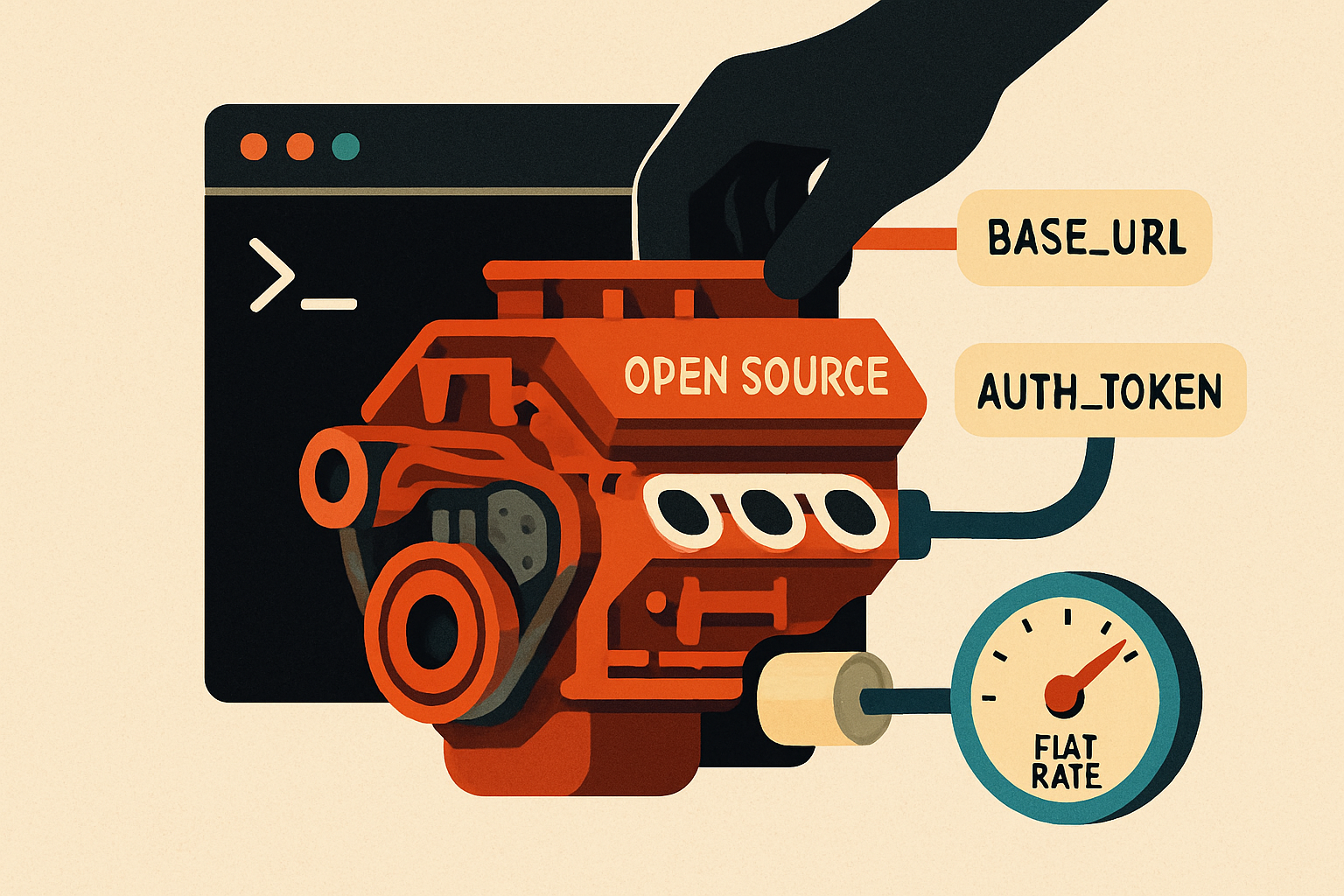
Run GLM-5.2 Inside Claude Code: A 5-Minute, Flat-Rate Setup
Keep the Claude Code workflow you already know; swap the engine underneath for an open-weight model on a flat monthly plan. The whole trick is two environment variables and one endpoint — here's the copy-paste path, plus the three mistakes that send people to a 404.
3 min
GitHub Copilot Went Usage-Based: Which Tier a Solo Founder Should Actually Pick
Since June 1, Copilot bills by AI Credits, not requests — and added a $100 Max tier for agent-heavy work. The good news for light users: your inline completions are now free. The trap: agent mode burns credits fast.
3 min
The Coding-Agent Market Didn't Pick a Winner — Standardize on the Stack, Not the Tool
OpenAI now ships an official plugin that runs Codex inside Anthropic's Claude Code. The founder question flipped from 'which agent' to 'what do I standardize on so I'm not locked in' — here's the answer.
5 min
Tool Highlight: OpenCode — the Free, Model-Agnostic Coding Agent You Can Self-Host
What OpenCode is, who it's for, how to start in one command, what it costs (as of July 2026), and the honest catch — the terminal coding agent that refuses to lock you to a single model vendor, now at ~7.5M developers.
3 min
GitHub Copilot Added Its First Open-Weight Model. The Story Isn't the Price — It's the Exit.
Kimi K2.7 Code landed in Copilot's model picker on July 1. Every other model there is a black box you rent. This is the first one whose weights are on Hugging Face — the first row with a way out.
4 min
How to Switch GitHub Copilot to Kimi K2.7 (and What It Actually Saves You)
The first open-weight model in Copilot's picker is also the cheapest tier. Here's how to enable it org-wide, when to route to it versus a frontier model, the real cost math, and the self-host fallback that makes it a floor, not a hope.
4 min
vLLM v0.24 Makes Model Runner V2 the Default. The Win Isn't a Faster Kernel — It's Never Waiting on the CPU.
The June 29 release flips vLLM's rebuilt execution core on by default and lands a Rust serving front-end. The throughput comes from deleting the CPU–GPU sync, not from a hotter matmul.
5 min
How to Build a Coding Agent (The Loop Is the Easy Part)
A working coding agent is a few hundred lines and four tools — a weekend. What separates a toy from Claude Code is everything that isn't the loop: the edit contract, what you keep out of context, and whether it runs the tests.
4 min
Claude Code Dynamic Workflows vs Subagents: When to Move the Plan Into Code
Subagents let Claude delegate a few tasks per turn. Dynamic workflows fan out hundreds. The line between them isn't how many agents you need — it's whether the plan is stable enough to freeze into a script.
4 min
Running Open Models in Claude Code: What the Anthropic-Compatible Endpoint Silently Turns Off
GLM-5.2, Kimi, and MiniMax all ship an Anthropic-compatible endpoint, so pointing Claude Code at them is a one-line base-URL swap. The model runs — but 'compatible' is a promise about the wire format, not about the harness features your bill and your speed depend on.
4 min
Claude Code Nested Subagents: The Depth Cap Is 5, but Your Token Bill Is the Real Limit
Subagents can now spawn subagents five levels deep. The number that decides whether you should is not the depth — it's how much billed work happens at branches the root never reads.
4 min
AGENTS.md vs Agent Skills: What Vercel's Evals Actually Prove
A compressed 8KB index in AGENTS.md scored 100% on Vercel's coding-agent evals; Skills topped out at 79% — because the agent skipped invoking the Skill 56% of the time. The lesson isn't "dumb beats smart."
5 min
OpenCode vs Claude Code: You're Comparing a Harness to a Product
OpenCode passed Claude Code on GitHub stars this year, and everyone rushed to benchmark them against each other. But one of them has no benchmark score of its own — and that's the whole point.
4 min
Cursor's DuneSlide Flaws: When a Path Check Fails Open, Prompt Injection Becomes RCE
Two zero-click Cursor flaws let a poisoned MCP response overwrite the editor's own sandbox binary. The root cause wasn't a bad command — it was a path validator that failed open.
5 min
Claude Code Agent Teams vs Subagents: When Your Workers Need to Talk to Each Other
Claude Code's new experimental Agent Teams let parallel sessions message each other and share a task list. The real question isn't 'do I want parallelism' — subagents already give you that — it's whether your workers need to disagree.
5 min
How to Evaluate an AI Coding Agent
Public leaderboards answer 'which model is smartest,' not 'will it fix my bugs' — the only test that predicts your outcome is a private eval built from your own repo.
7 min
When "Trust This Folder" Means Remote Code Execution: The Amazon Q Flaw Every Coding Agent Shipped
Amazon Q auto-ran an MCP config out of any repo you opened, with your live AWS keys in the process. It got a CVE. The identical bug in Claude Code, Cursor, Gemini CLI and Copilot got declared working-as-designed — because the trust prompt you inherited from your editor was never a consent to run code.
5 min
Does an AGENTS.md File Actually Make Your Coding Agent Better?
The first rigorous benchmark of repository context files is in, and the answer is uncomfortable: the auto-generated ones make agents slightly worse, the hand-written ones barely help, and both raise your bill ~20%.
5 min
Google Antigravity vs Cursor vs Claude Code: What 'Agent-First' Actually Moves
Google's Antigravity, Cursor, and Claude Code now all hit ~80% on SWE-bench. So the real difference isn't who writes better code — it's where each one puts the work of checking it.
5 min
Fast-Apply Models: How Cursor, Morph, and Relace Write Edits at 4,000+ Tokens/Second
The bottleneck in a coding agent isn't the smart model deciding what to change. It's the dull mechanical work of writing that change to disk correctly — and that's a different model entirely.
5 min
Background Coding Agents: Devin vs Codex vs Cursor vs Jules vs Copilot
The async coding agents have all converged on the same shape — a cloud VM that clones your repo, runs the tests, and opens a PR. So the thing you're actually choosing isn't the coder. It's the harness and who reviews the flood.
5 min
Git Worktrees Solve the Easy Half of Parallel AI Agents
Worktrees stop your agents from overwriting each other's files. They do nothing about the shared database, the fight over port 3000, or the review queue that becomes your real bottleneck.
5 min
Cline vs Roo Code vs Kilo Code: Picking a VS Code Agent in 2026
Three open-source coding agents from one family tree — and the middle child just shut itself down. Its death is the most useful thing in the comparison.
4 min
Spec-Driven Development: Spec Kit vs Kiro vs Tessl
Writing a spec before the agent writes code is the loudest idea in AI coding right now. The pitch isn't better code — it's making intent a durable artifact that survives the context window. Three tools bet on that at three different altitudes.
5 min
Lovable vs Bolt vs v0 vs Replit: Choosing an AI App Builder in 2026
They all promise an app from a prompt. They differ on the question none of them advertises: when you outgrow the tool, do you get to take the code with you?
4 min
How AI Coding Agents Edit Code: Diff vs Whole-File vs Search-Replace
Everyone argues about which model to use. The under-discussed variable is how the agent writes its changes to disk — and that edit format is often the real bottleneck.
5 min
CodeRabbit vs Greptile vs Qodo: Choosing an AI Code Review Tool in 2026
Every vendor leads with its bug-catch rate. But code review is the one place in the AI stack where precision beats recall — a reviewer you learn to ignore catches nothing.
4 min
Claude Code vs Codex CLI vs Gemini CLI: Picking a Terminal Coding Agent in 2026
Three bets on the same idea — that the command line, not the IDE, is where coding agents live. And as of this month one of the three just changed its name and its terms.
4 min
AGENTS.md vs CLAUDE.md: One File to Brief Every Coding Agent
The config-file war for how you talk to a coding agent didn't end with a winner. It ended with a foundation — and that changes which file you should actually write.
4 min
Cursor vs Windsurf vs GitHub Copilot vs Claude Code: Choosing an AI Coding Tool in 2026
The four tools map to four architectural postures — and in a year when the companies keep getting acquired out from under their users, the posture is what you're actually choosing.
5 min
Aider vs Cline vs OpenHands: Three Shapes of an Open-Source Coding Agent
They aren't ranked by capability. They differ on where the agent runs and who holds the steering wheel — and that decides your blast radius, not your benchmark score.
5 min