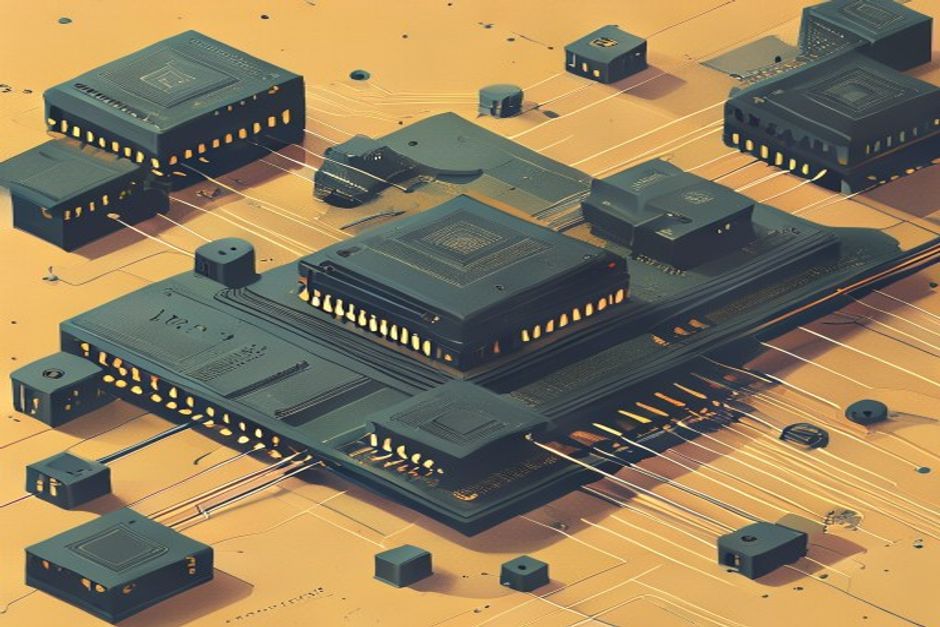
Google is reportedly building a server chip that would etch part of Gemini's own architecture directly into the transistors. Informally called "Frozen v2," it's a report from The Information (around July 20, 2026), not a product — nothing has shipped, and deployment is targeted for as soon as ~2028. But the number attached to it is loud: engineers on the project project 6-10x more tokens per watt than Google's newest TPUs.
If you only take one thing from this, take the bet underneath the chip, not the chip: Frozen v2 is a wager that the transformer's shape has stopped changing enough to be worth casting in silicon.
What "freezing" actually means#
A normal accelerator — a TPU, a GPU — is deliberately general. It doesn't know or care what model it's running; it just does fast matrix math and shuttles data around. That generality is exactly the overhead. Every query pays for calculations and data movement that a chip built for one specific model wouldn't need.
Frozen v2 removes that overhead by fixing some of Gemini's architectural decisions — the structural choices of the model, not its knowledge — into the hardware itself. Fewer general-purpose steps, less data moved per query, so more tokens out per unit of power. Crucially, it freezes the architecture and leaves the weights updatable. The chip is meant to stay useful across Gemini releases, but only for as long as Google keeps building them on the same underlying shape.
That "weights stay editable" detail is the whole design. The original "Frozen" — reportedly spearheaded by DeepMind chief scientist Jeff Dean — went further and would have baked the weights in too. Google reportedly set that aside: silicon tied to one model version has too short a life cycle. Frozen v2 is the more conservative bet. It doesn't need Gemini to stop learning. It needs Gemini to stop restructuring.
This is a chip you can only build once the architecture stops surprising you. That it's being taped out at all is a statement that the transformer has quietly settled.
Why now: you can't buy your way out#
The motivation reported is blunt and physical. The project is partly a response to an AI compute shortage severe enough that Google Cloud has reportedly turned down deals with outside customers. When you can't buy enough capacity, you squeeze more output out of the capacity you have — and the cheapest place to find 6-10x is by deleting generality you don't use.
Note what Frozen v2 is not. It's reported to sit alongside TPUs, not replace them. Google's TPU line already forked at its eighth generation, announced at Cloud Next in April 2026, into separate training and inference variants. Frozen v2 is a further specialization down that same road: an inference part for one model family. The TPU-vs-GPU tradeoff was already about trading flexibility for efficiency. Frozen v2 is that dial turned as far as it goes — flexibility of exactly one architecture, in exchange for multiples of efficiency.
What it means for founders#
The chip is Google's problem. The direction is yours.
Inference cost is going to keep diverging by who owns the silicon. If a hyperscaler can hardwire its own model for 6-10x efficiency, the per-token economics of running that first-party model on that custom silicon pull away from everyone renting general-purpose GPUs. This is the same logic as Etched's Sohu bet — an ASIC that etches the transformer itself — except now it's a hyperscaler doing it for a model only it can run. The gap that opens isn't between chips. It's between your per-token cost and Google's.
The moat deepens where model and metal are co-designed. A first-party model on a model-specific chip is a bundle a competitor can't unbundle. That sharpens the oldest tradeoff in this business: the cheapest tokens will increasingly come with the tightest lock-in. If your product is glued to one provider's model and that provider's silicon economics, your portability story is a spreadsheet assumption, not an architecture.
But the whole thing rests on "frozen." Etching architecture into silicon only pays off if the architecture holds still through a ~2028 deployment and beyond. If the next real jump in capability comes from a structural change — not more weights but a different shape — a frozen chip is a very expensive bet on yesterday's design. Sohu's team made the same wager on the transformer; Frozen v2 makes it on Gemini specifically. The upside is enormous efficiency. The risk is that "settled" turns out to mean "settled until it isn't."
For now, plan for the direction, not the datasheet. First-party tokens on custom silicon get cheaper and stickier; the arbitrage of renting general-purpose GPU capacity gets thinner for the exact workloads a hyperscaler has hardwired. Keep an escape hatch to more than one model, and treat any per-token price that depends on a chip that doesn't exist yet as what it is: a projection, dated ~2028, reported and not shipped.