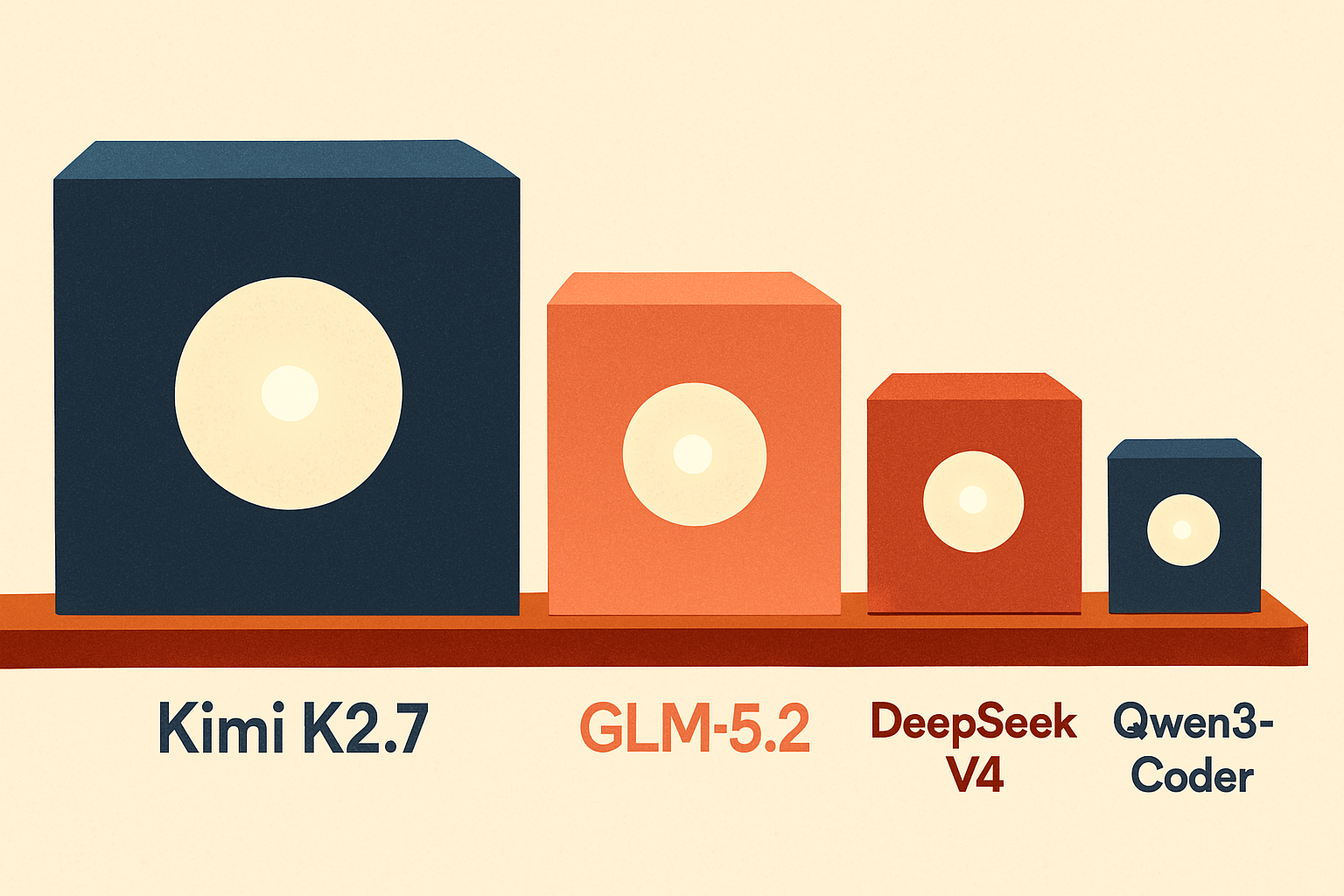
The one-line answer: for a coding agent, pick your open-weight model by which bill you pay — cheapest API call (DeepSeek V4 Flash), best long-horizon agentic quality (GLM-5.2), or self-host-and-license clarity (Qwen 3.6-Plus) — because the model that tops the headline benchmark is a 1.6-trillion-parameter model most teams can't actually run.
The China open-weight field consolidated fast this summer. In late July the question was Kimi K3 vs GLM-5.2 vs DeepSeek V4, picked by license and serving cost; a month before that it was GLM-5.2 vs MiniMax M3 vs Kimi K2.7. Now Qwen 3.6-Plus is in the same budget with an Apache-2.0 license, DeepSeek V4 has split into a giant Pro and a tiny Flash, and the honest news is that all of them clear the quality bar for most agent loops. So this piece isn't another "who's on top" — it's the two places the leaderboard actively lies to you: the top model you can't run, and the benchmark that flips the ranking. Here's how it splits.
1. The benchmark leader and the agentic leader are different models#
The single most misleading thing you can do is sort by SWE-bench and take the top row. Because which SWE-bench you read flips the answer:
- On SWE-bench Verified — the older, more saturated set of well-scoped fixes — DeepSeek V4 Pro leads this field at a reported 80.6%, with Qwen 3.6-Plus close behind at ~78.8% (Morph leaderboard).
- On SWE-bench Pro — the harder, multi-file, long-horizon set that looks more like real agent work — GLM-5.2 leads at 62.1%, versus DeepSeek's 55.4% (OpenRouter).
Same field, opposite rankings, because the two benchmarks reward different things. If your agent does short, well-scoped edits, Verified is the better predictor. If it runs long autonomous loops across a repo — the thing most people mean by "agentic coding" — Pro is, and GLM-5.2 is your default. Read the benchmark name before you read the number.
The leaderboard doesn't tell you which model is best. It tells you which benchmark you're looking at.
2. "Open weights" is not the same as "you can run it"#
DeepSeek V4 Pro tops SWE-bench Verified. It is also a 1.6-trillion-parameter Mixture-of-Experts model (~49B active per token) with weights on the order of terabytes (model card). It does not fit on a single 8×H100 node; reported deployments use 4×H200 141GB or multi-node (DeepSeek V4). The MIT license is real, but it buys you a download, not a deployment your startup can afford.
That's the trap. "It's open weights" gets treated as "so I can self-host it and dodge API costs," and for V4 Pro that's false for anyone without a serious GPU budget. The models you can genuinely self-host on owned hardware are the smaller ones:
- DeepSeek V4 Flash — 284B total / 13B active, reported to run on dual RTX 4090 or a single RTX 5090.
- Qwen 3.6-Plus — the self-host-friendly member of the field, 1M context, and the one with the cleanest license for it.
If self-hosting is your reason for going open, V4 Pro isn't the answer — it's the API-or-rent-big-iron option that happens to have public weights.
3. The cost spread is ~10× — so cost should drive the routing#
Across this field, per-token price ranges by roughly an order of magnitude:
- DeepSeek V4 Flash: ~$0.14 in / $0.28 out per 1M tokens (pricing) — the floor.
- Qwen 3.6-Plus: ~$0.28–0.33 in / ~$1.95 out (TokenMix).
- DeepSeek V4 Pro: ~$0.435 in / $0.87 out.
- GLM-5.2: ~$1.40 in / $4.40 out first-party (as low as ~$0.75 in via resellers).
That's a clean 10× on input and up to ~15× on output from cheapest to priciest. For an agent loop burning tens of millions of tokens a day, that's not a rounding error — it's the whole infrastructure line. Since all four clear the quality bar for most workloads, the price gap, not the benchmark gap, is the decision that moves your P&L. This is the same logic that made the GPT-5.6 Luna 80% cut worth recomputing your routing over — the open-weight field just gives you more rungs on the ladder.
4. License and context: one still matters, one is settled#
License is a genuine differentiator only at the edges. Qwen 3.6-Plus ships Apache 2.0 — permissive plus an explicit patent grant, which tends to clear enterprise procurement fastest. DeepSeek V4 (Pro and Flash) is MIT; GLM-5.2's weights are MIT as well. All three let you download and fine-tune without a negotiation. If your legal team specifically wants a patent grant, Qwen wins; otherwise MIT is not a blocker.
Context is settled. All four now advertise ~1M-token windows. It used to separate these models; it no longer does. Stop routing on context length and treat it as table stakes.
The decision, in one pass#
- Cheapest capable API call → DeepSeek V4 Flash.
- Best long-horizon agentic quality → GLM-5.2.
- Self-host on owned hardware, or need Apache-2.0 → Qwen 3.6-Plus.
- Max open quality, and you'll rent the iron or pay Pro API rates → DeepSeek V4 Pro.
And keep it swappable: all four expose OpenAI-compatible Chat Completions, so if you keep conversation state in your own store and put the model behind one variable, moving between them is a two-line change. That's the real prize of building on the open-weight field — not the top benchmark row, but the freedom to change your mind about it next month for the cost of an environment variable. For the full cost model of an agent that actually ships, see what it costs to run a coding agent in August 2026.