Three months ago the open-weight coding tier looked like Kimi K2, GLM-4.6, MiniMax M2, and Qwen3. The thesis then was that the headline parameter counts were nearly decorative and you should pick by active params and post-training. That thesis held up better than the roster: nearly every model on it has since been replaced. Here's the July 2026 bracket, and the same discipline — because the field got faster, not more honest.
The four to know: Kimi K2.7-Code (Moonshot, June 12), GLM-5.2 (Z.ai, June 13), DeepSeek V4-Pro (April 24), and Qwen3-Coder-Next (Alibaba, February 3). All four ship weights you can actually deploy — modified MIT, MIT, MIT, and Apache 2.0 respectively. That's the quietly remarkable part: the permissively-licensed frontier of coding models is now a real, crowded competition, and three of the four come from Chinese labs.
The number that sets your bill: active parameters#
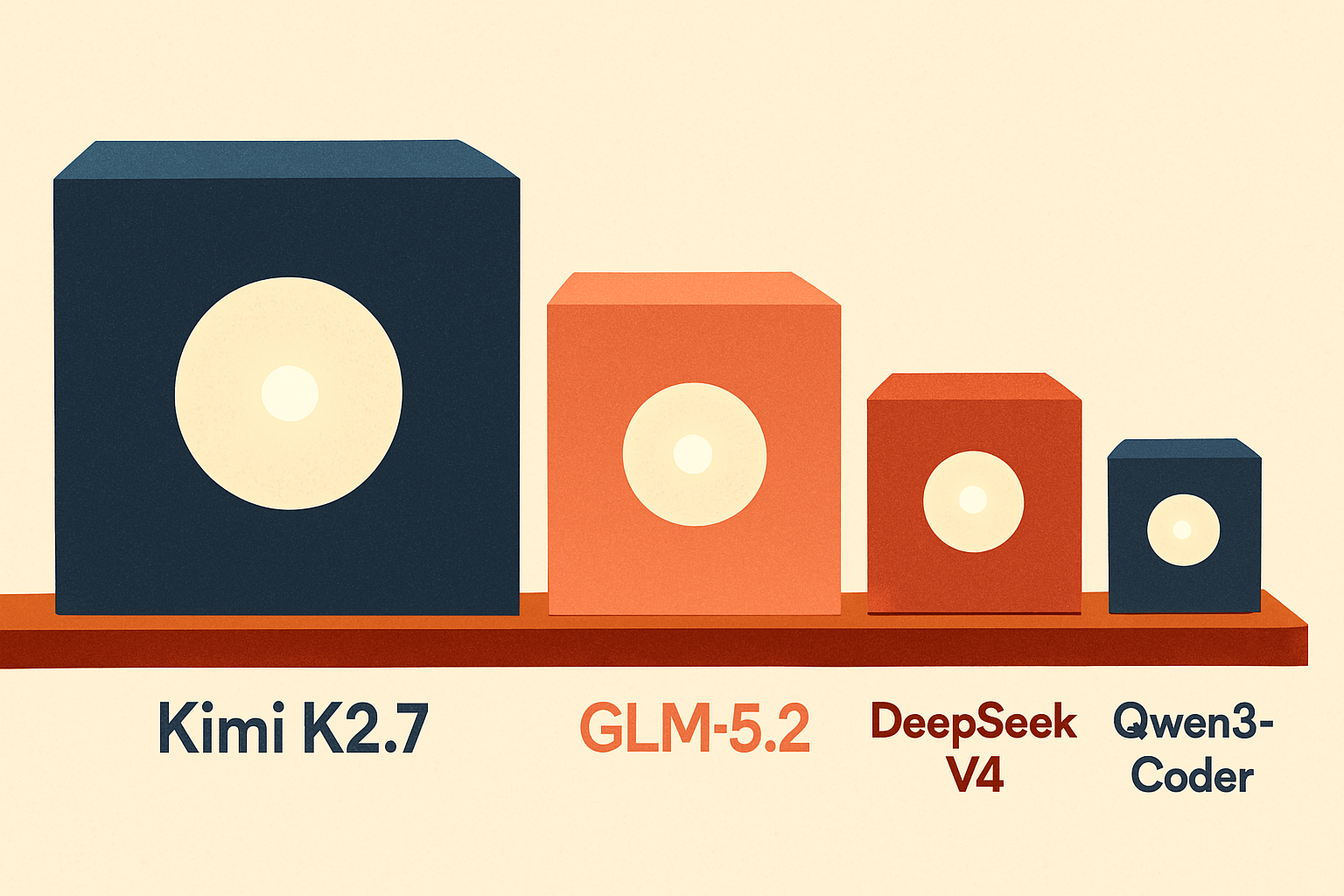
If you self-host, the total parameter count is a vanity metric. What you pay for — GPUs, latency, throughput — tracks active parameters, the slice of the mixture-of-experts that actually fires per token. And the spread here is enormous:
- Qwen3-Coder-Next — ~80B total, but only ~3B active. A hybrid MoE built to be cheap.
- Kimi K2.7-Code — ~1T total, ~32B active.
- GLM-5.2 — ~744B total, ~40B active.
- DeepSeek V4-Pro — ~1.6T total, ~49B active (there's also a lighter V4-Flash at 284B/13B).
That is more than a 10x gap in serving cost between the cheapest and priciest to run, all wearing the same "open-weight" label. Qwen3-Coder-Next's ~3B active is the outlier that reframes the whole comparison: it's the model you can plausibly run on modest hardware and still get near-frontier SWE-bench numbers out of.
Context: a clean 4x split#
Two of the four target whole-repo work and two don't. GLM-5.2 and DeepSeek V4 offer roughly 1M tokens; Kimi K2.7 and Qwen3-Coder-Next offer 256K (Qwen extrapolates toward 1M, but its native window is 256K). For an agent that needs to hold a large codebase in view, that gap is decisive before you've looked at a single benchmark.
Now the benchmarks — and why you should squint#
Here's the uncomfortable part, and it's the same every quarter: almost every coding score these labs publish is vendor-reported, run on the vendor's own scaffold. Treat the following as claims, not verdicts.
- DeepSeek V4-Pro claims SWE-bench Verified 80.6% (in its "Think Max" mode) and LiveCodeBench 93.5 — the strongest SWE-bench headline on the list.
- GLM-5.2 claims SWE-bench Pro 62.1, Terminal-Bench 2.1 81.0, and GPQA-Diamond 91.2 — and, critically, it's the one model here with an independent datapoint we could find: Artificial Analysis puts its Intelligence Index at 51, which it calls the highest of any open-weight model.
- Qwen3-Coder-Next is reported in the low-70s% on SWE-bench Verified, but the exact figure slides depending on whether it's run under SWE-Agent or OpenHands — a live reminder that the harness moves the score as much as the model does. Treat the number as directional; its real story is the active-param count, not the leaderboard row.
- Kimi K2.7-Code is the honesty test. Moonshot published only relative gains over its predecessor K2.6 (+21.8% on its own Kimi Code Bench v2, among others) and no absolute score on any public suite at release. Don't borrow K2.6's old SWE-bench numbers to fill the gap — that's a different model.
One independent benchmark across four flagship models. The leaderboard screenshot is not evidence; it's marketing with a monospace font.
What to actually do#
Shortlist by constraint, then verify with your own eval — the discipline the coding-agent evaluation playbook exists for.
- Self-hosting on a budget? Qwen3-Coder-Next. ~3B active is the cheapest near-frontier coding model to run, full stop.
- Whole-repo agent that needs long context plus one outside signal? GLM-5.2 — ~1M tokens, MIT, and the only independent benchmark in the group.
- Cheapest hosted API with a strong SWE-bench claim? DeepSeek V4-Pro at ~$0.44/$0.87 per Mtok (reseller rates) and a 1M window. Verify the 80.6% against your tasks before you believe it.
- Already in Moonshot's ecosystem? Kimi K2.7-Code is a real upgrade — but demand your own numbers, because the lab didn't give you public ones.
The roster turned over in a quarter; it will turn over again. What doesn't change is the method: license, context, active-param cost, then your eval. Rank on the vendor's screenshot and you're not choosing a model — you're choosing whose marketing you trust.