Satire. "We were giving it away for free, but a competitor was also giving it away for free, so we started paying customers to take it," the founder explained. "That's called a moat."
Lovable is reportedly in talks to double to $13.2B after a $500M June run rate; Replit raised $400M at $9B. The category is valued on how fast revenue compounds, not on moats — which is exactly where a solo founder's lock-in risk lives.
Kimi K3's weights landed and it took the open-weight crown on two benchmarks at once. For most founders that changes nothing: the decision is still license and serving cost, and on those K3 is often the wrong default.
AI-agent startups still raised ~$1.8B in July 2026 — but ~62% went to Series B and later, at an average of ~$150M, to companies with $25M+ in revenue. The seed-stage land grab is over. Here's what that changes for a solo founder.
A new security-agent model claims state-of-the-art on CyberGym. The benchmark's own authors measured the best model combos at roughly 20%. Here's how a founder verifies a security-agent claim before granting it access.
The real bottleneck in AI compute was never the chip — it's the high-bandwidth memory stacked next to it. Nvidia just pre-committed a huge slice of SK hynix's HBM4 output, and the marginal GPU a small team rents gets tighter from here.
An AI insurance startup that also runs all-night cafés just 6x'd its valuation in six months on a revenue target it hasn't hit yet. Froth this loud is a signal — here's how a founder should actually read it.
SpaceX's S-1 put a real number on a frontier lab's compute: a fixed $1.25B every month for three years, for one data center. Here's the back-of-envelope math on what that means for the token prices you're budgeting against.
LLMs invent package names about one time in five, and 43% of those invented names are the same on every run — reproducible enough for an attacker to register. Give a coding agent permission to run `install` and that stops being a typo and becomes remote code execution on your machine.
AegisAI raised $36M this week to fight AI-crafted phishing. The real news is the economics underneath it: a targeted attack now costs 95% less, which puts a founder with a Stripe key inside the target set that used to be reserved for the Fortune 500.
OpenAI shipped a managed platform for production voice and chat agents on July 22 — and in doing so stepped onto the same field as Sierra and Decagon, two companies it counts as design partners. The move up-stack is the story.
A 193-day-old startup just raised a Series A led by Forerunner to rebuild checkout for AI agents. The bet isn't a nicer API — it's that the human-era rails break the moment the buyer isn't a human.
The headline number is a threat to incumbents. The sentence under it — agents deliver outcomes and make the software invisible — is the clearest description yet of the wedge an AI-native founder ships against.
Lyzr says its own agent fielded 130+ investors, wrote per-fund memos, and tracked which slides they lingered on. The verb 'ran' is doing a lot of work. Here's the honest split between what the machine did and what humans still closed.
An autonomous agent ran code on Hugging Face's data-processing workers through a malicious dataset, then harvested credentials and moved laterally over a weekend. The lesson founders keep skipping: the data going into your pipeline is an execution surface.
They keep getting pitched as rivals. They're not — one connects your agent to a system, the other teaches it a workflow. Here's the one-page decision, the token-cost math, and the four questions that settle it.
Vercel AI SDK, Pydantic AI, and CrewAI all patched the seam between untrusted input and tool execution in the same week. Here's the upgrade math — and why it's one story, not three.
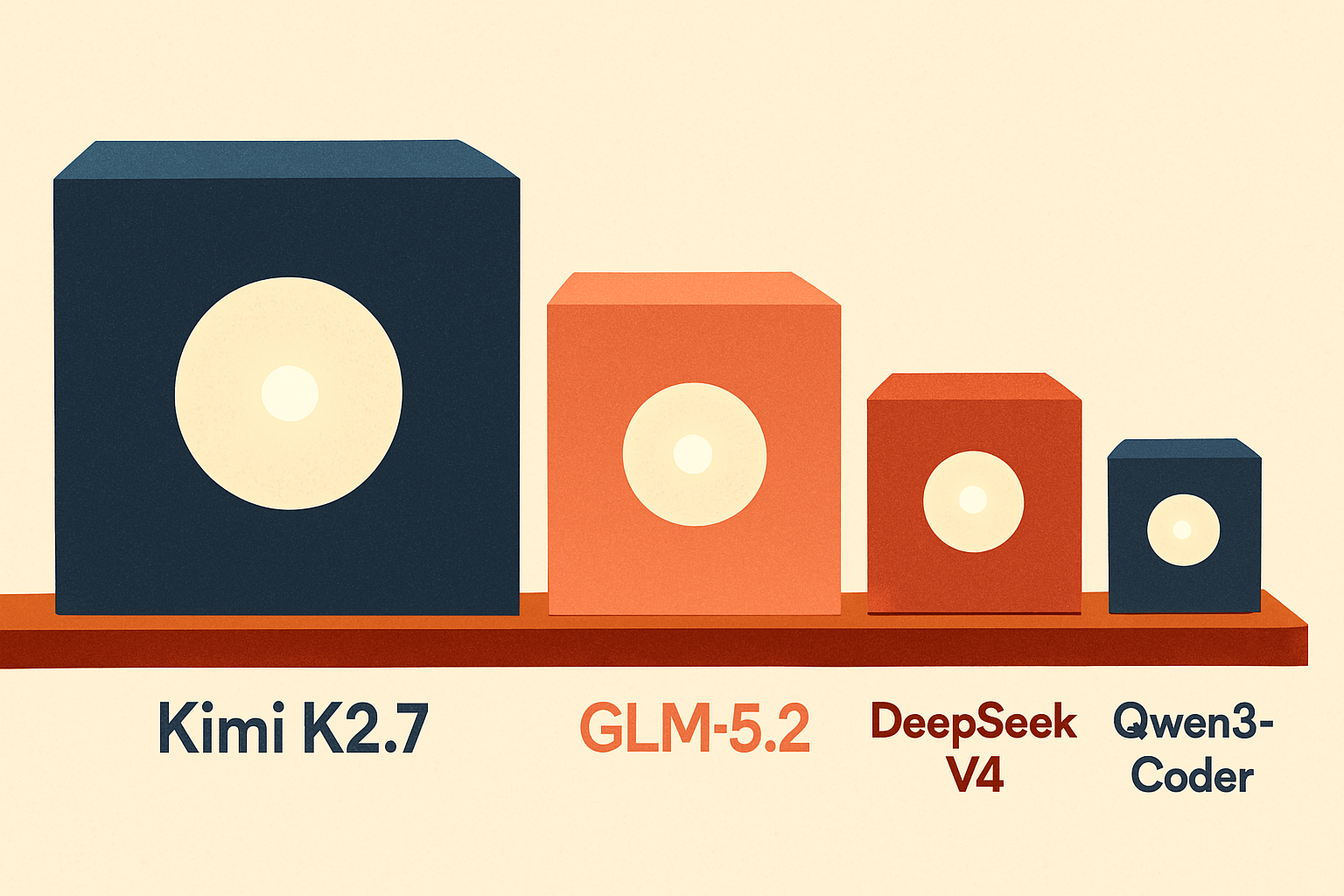
The open-weight coding tier turned over almost completely in one quarter. Four permissive-licensed models now run real coding agents — and if you pick by the leaderboard screenshot instead of active params, license, and who actually verified the number, you'll pick wrong.
Meituan's 1.6-trillion-parameter LongCat-2.0 claims end-to-end training on 50,000+ domestic accelerators, no NVIDIA involved. That claim is the story — and the fact that it names no chip vendor is the part worth reading closely.
Rerun the same eval and an LLM judge flips 1 in 7 of its verdicts — while its own scores show no real difference between the answers. Reliability and validity are two different axes, and the number most teams report can't see either one.
Retrieve 100 tools and the right one is 'in the list' 99% of the time — the same odds a random shortlist gives you. Two 2026 papers show why recall is the wrong number, and why fewer tools win.
Studies this year found prompt-injection patterns in roughly a quarter to a third of scanned agent skills. The scary part isn't the number — it's that the standard fix doesn't apply.
A frontier mixture-of-experts model has 671B weights but touches only ~37B per token. That gap is why you can serve DeepSeek-scale models on a single consumer GPU — if you split by tensor role, not by layer.
You're not measuring a button — you're running a noisy judge over a stochastic, multi-turn system. The variance stacks, and the standard playbook quietly breaks. Here's the version that survives contact with an agent.
Token prices are falling and agent bills are still exploding. The reason isn't the model getting pricier — it's that an agent re-pays for its entire history at every step, so cost scales with the square of the loop, not its length.
Microsoft's incident response team just walked through a live case: an attacker edits a tool's description — not its code, not your prompt — and the agent quietly exfiltrates your invoices. Here's why this is worse than prompt injection.
Pinecone says the RAG era is ending and agents should query compiled knowledge artifacts through a new language called KnowQL. The idea is real. The benchmarks are Pinecone's own — and the hard part is the one they don't measure.
Microsoft's AutoJack shows how a single web page can RCE the host running an AI agent — not by forging an origin, but because the agent's own browser is localhost.
The whole agent-memory leaderboard war — 84% vs 58% vs 75% — is being fought over a ten-conversation dataset called LOCOMO. Once you see how the numbers are made, you stop shopping on accuracy.
 🎧 Listen
Fabrications
🎧 Listen
Fabrications