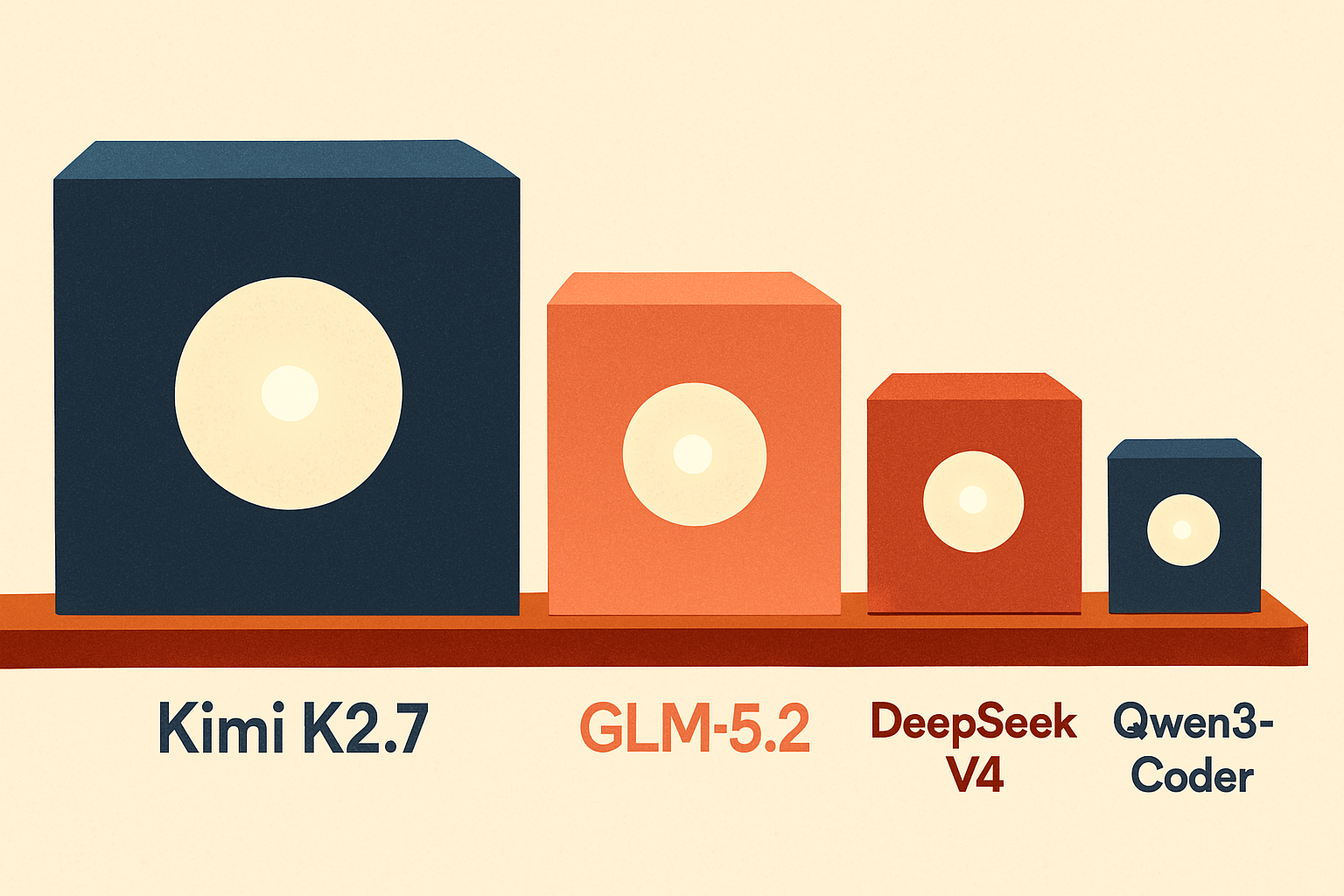
For six weeks the open-weight coding tier had a comfortable, tidy story: three models, each king of a different hill. On July 27 that story broke. Moonshot AI shipped Kimi K3's weights to Hugging Face, and K3 immediately took the top open-weight spot on two leaderboards at once — the Arena.ai Frontend Code Arena and the Artificial Analysis Intelligence Index. The smartest downloadable model in the world is now Chinese, open, and named Kimi K3.
Here is the part the leaderboard tweets leave out: that should change almost nothing about which model you actually ship. For a founder, this decision has never been won on the Intelligence Index. It is won on two things the leaderboard does not show — the license and the serving cost — and on both of those, K3 is frequently the wrong default. Below is the honest three-way, with the numbers that matter.
The 30-second answer#
- Kimi K3 — the new intelligence and frontend champion. Also the most expensive, the hardest to self-host (~1.56TB of weights), and the only one with a custom license carrying a revenue gate. Pick it when frontend/UI generation or top raw reasoning is the product.
- GLM-5.2 — the pragmatist's default. A real MIT license, near-top intelligence, and the best intelligence-per-dollar. Pick it when you want most of K3's smarts with none of the fine print.
- DeepSeek V4 — the SWE workhorse. Leads standardized SWE-bench Verified among open weights, MIT-licensed, and V4-Flash is the cheapest tokens and the easiest here to self-host. Pick it when your work is real-repo software engineering or high-volume and cost-bound.
Kimi K3 won the crown — and priced itself out of most defaults#
The benchmarks are real. K3 sits at #1 on the Frontend Code Arena (1,679 points, ahead of Claude Fable 5 and GPT-5.6 Sol) and posts an Intelligence Index of 57, the top open weight and comparable to Opus 4.8 and GPT-5.5 (Arena.ai; Artificial Analysis). It is a ~2.8T-parameter MoE (~104B active per token) with a 1M-token context and native vision. As a piece of engineering it is the front of the open pack.
Now the fine print. K3 ships under a custom "Kimi K3 License," not MIT (DigitalApplied). You can download and run the weights, but a Model-as-a-Service operator past roughly $20M in revenue over any 12 months needs a separate agreement with Moonshot, and large consumer products must display "Kimi K3" in the UI. That gate won't touch most small teams — but it is a term GLM-5.2 and DeepSeek V4 simply don't have, and we've broken down the $20M line founders miss separately.
Then cost. The weights are about 1.56TB — the largest open release to date, so self-hosting is a real infrastructure project, not a weekend. And by API, K3 is the priciest of the three, reported around $3/1M input and $15/1M output (kimi.com). If frontend generation or hard reasoning is your core loop, that's money well spent. If it isn't, you're paying a premium for a crown you don't use. (For the full picture, see our Kimi K3 founder guide.)
The benchmark trap to avoid: you'll see K3 quoted at 93.4% on SWE-bench Verified. That figure is from Moonshot's own harness, and harness choice alone can move SWE-bench scores by 10–26 points (emergent.sh). It is not comparable to standardized numbers. Do not use it to conclude K3 wins agentic software engineering — because on the standardized version, it doesn't.
GLM-5.2 — the best intelligence-per-dollar, with a clean license#
GLM-5.2 (Z.ai, released ~June 17) was the #1 open weight on the Intelligence Index until K3 passed it — it now sits at score 51, a hair behind. But it wins the two categories K3 loses. It is MIT-licensed — the most permissive of the three, no revenue gate, no attribution clause. It is smaller and cheaper to serve at 744B total / ~40B active with a 1M context. And at a reported $1.40/1M input and $4.40/1M output, roughly a sixth of a frontier closed model's price, it delivers the best intelligence-per-dollar in open weights (Artificial Analysis; OpenRouter).
Pick GLM-5.2 if you want most of K3's capability, a license you never have to think about, and a model you can actually afford to run. For most founders building agentic coding tools, this is the sane default — the reasoning we laid out in GLM-5.2 for open-weight agentic coding.
DeepSeek V4 — the standardized-SWE winner and the cheapest way in#
If your work is patch generation and real-repo bug-fixing, the number that matters is standardized SWE-bench Verified — and there DeepSeek V4 Pro leads the open field at ~80.6% (Morph). It's MIT-licensed (weights on Hugging Face), reached GA around July 19, and comes in two sizes: V4-Pro (1.6T/49B active) and V4-Flash (284B/13B), both with 1M context.
V4-Flash is the quiet winner for cost-bound teams: at a reported $0.14/1M input and $0.28/1M output, it is the cheapest tokens of the three by a wide margin and, at 13B active, the easiest of these models to self-host on modest hardware. The Pro-vs-Flash trade-off for agents is its own decision, but the headline is simple: DeepSeek is where you go when the yardstick is SWE-bench or the budget is the constraint.
The decision, honestly#
Rank by the benchmark that reflects your work — frontend, general reasoning, or standardized SWE — then let license and serving cost break the tie:
- Frontend or top raw reasoning is the product → Kimi K3, if you can pay the API or serve 1.56TB, and the license gate doesn't bite.
- You want near-top intelligence per dollar with a clean MIT license → GLM-5.2. The pragmatic default.
- Agentic software engineering, or cheapest/easiest to self-host → DeepSeek V4 Pro (accuracy) or V4-Flash (cost).
Whichever you pick, the next move is the same: watch what it actually does in production, because a cheaper model that quietly retries or loops can erase its own savings. That's a second buyer's decision with the same shape — choose by the question you have, not the brand — and we mapped it in which agent-observability archetype fits you.
Kimi K3 winning the crown on July 27 is real news. Letting a leaderboard you don't benchmark against pick your production model is how a founder overpays for capability the product never ships. The crown is Moonshot's. The decision is still yours — and it's usually cheaper than the top of the board.