The headline number is a speed record: OpenAI is serving GPT-5.6 Sol, the flagship of the three-tier family it previewed on June 26, on Cerebras wafer-scale chips at up to 750 tokens per second — roughly ten times the throughput of a frontier model running on Nvidia GPUs in production. It runs on the back of a multi-year OpenAI–Cerebras agreement signed in January 2026 that reserves 750 megawatts of capacity specifically for low-latency inference.
Records are fun. This one is also a category shift, and that's the part worth your attention. Because the interesting question isn't "how fast is 750 tokens per second" — it's "what becomes buildable at 750 that wasn't buildable at 75."
The threshold, not the number#
Do the arithmetic that actually matters to a product. A typical chat response is on the order of 1,000 tokens. At the ~75 tok/s a frontier model musters on GPUs, that answer takes about 13 seconds to finish streaming. At 750 tok/s it finishes in about 1.3 seconds. For a full agent turn — read the context, reason, call a tool, respond — the gap compounds from "the user tabs away to Slack" into "the user never left the conversation."
There's a soft line, somewhere under two seconds of full-response latency, where an agent stops being a thing you submit a job to and becomes a thing you work inside. Above it you build async products: you fire a request, go do something else, come back to a result. Below it you build synchronous ones: live pair-programming that keeps up with your typing, a voice agent that answers like a person instead of a hold line, a research tool you interrogate in real time, agentic UI that reacts as you edit. Until now those either forced you down to a small, fast, dumber model or forced your users to wait. Frontier-quality reasoning at real-time speed collapses that tradeoff — and collapsing a tradeoff is how new product categories get born.
The speed record is a footnote. The story is that a frontier model just crossed the latency line between "wait for it" and "work inside it" — and everything on the fast side of that line is a product that couldn't exist yesterday.
Why it's fast, and why you shouldn't over-read the internals#
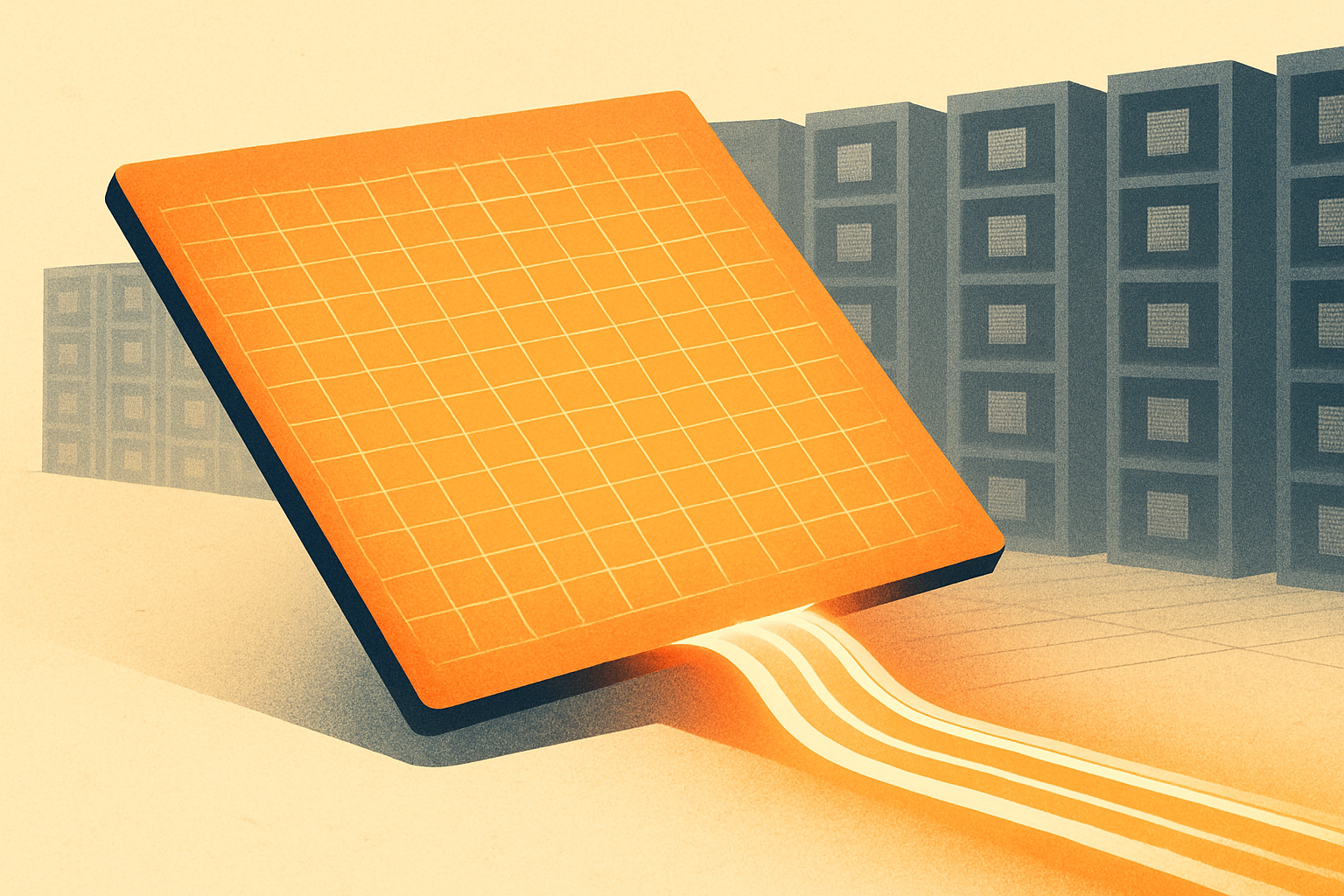
The speed isn't a tuning trick; it's the chip. A Cerebras WSE-3 is a single wafer-scale processor that keeps compute and the model's weights on the same piece of silicon, so it never stalls fetching parameters across a fabric of separate GPUs and memory — which is exactly the interconnect-and-bandwidth bottleneck that throttles large-model inference on conventional hardware. Independent teardowns estimate Sol is spread across 70 to 100 wafers, roughly one transformer layer per wafer, letting each token flow through the whole stack with minimal cross-chip latency. Treat that as an informed guess from people reading the physics, not a published spec — OpenAI hasn't confirmed the topology.
You don't need the internals to make the decision, though. You need one number: how fast does your product have to feel, and is a human waiting on the token when it does?
The trap: fast is not cheap#
Here is the mistake to not make. Speed and cost are different axes, and wafer-scale capacity is the premium end of the market — the OpenAI–Cerebras deal explicitly earmarks its 750 MW for latency-sensitive inference, not for cheap bulk tokens. Sol is also gated at launch to roughly twenty vetted partner organizations, with broader access expected mid-to-late July, so it's not yet a knob you can just turn on.
If your agent is background or batch — a nightly enrichment job, an async pipeline, a support triage that's perfectly fine answering in a minute — then 750 tok/s buys you nothing your users will notice, and you'd be paying a latency premium you never spend. There, cheaper GPU serving or a mid-tier model like Terra is the correct call, and the discipline is the same one behind all good agent latency work: find the exact place a human is blocked on a token and spend there, not everywhere. It helps to know your own numbers first — TTFT versus TPOT is the difference between "feels instant" and "streams smoothly," and a product usually needs one far more than the other.
So the right way to read this launch isn't "frontier models got fast." It's: a new tier exists now, and it's worth its premium only where latency is the product. Live and interactive? This is a moat you can rent. Async and batch? It's a line item you don't need. The 750 is real — the skill is knowing which half of your system, if any, actually deserves it.